
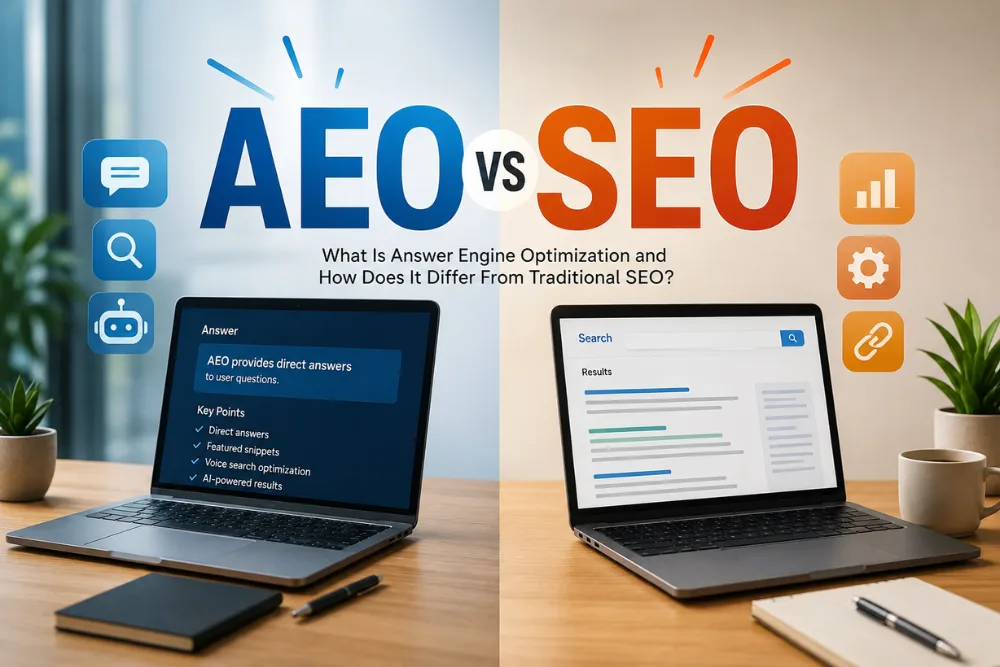
If you work in digital marketing field, you probably need a spreadsheet just to keep track of all these three letter acronyms. First, we had SEO. Then came AEO.
But before we start sending flowers to SEO, let’s clear something up: SEO is not dead, and AEO has not simply replaced it. Instead, search is evolving, and marketers are learning new ways to make content visible not only in traditional search results, but also in AI powered answers and generative search experiences.
Answer Engine Optimization, or AEO, is a digital marketing strategy designed to help AI powered answer engines understand, select, and present website content directly to users. While traditional SEO focuses on ranking web pages and attracting organic clicks, AEO focuses on making information clear, structured, and useful enough for AI systems to provide direct answers.
Answer Engine Optimization is an evolving approach to digital marketing that focuses on how content is understood and used by AI powered systems. Instead of concentrating only on where a webpage appears in search results, AEO aims to make content suitable for direct answers generated by systems such as ChatGPT, Google AI Overviews, Siri, Alexa, and other AI assistants.
The basic idea is simple. When someone asks a question, they increasingly expect an immediate and useful response. AI systems can interpret information from different sources and generate an answer without requiring the user to visit several websites.
Related search: Is Digital Marketing Legit?
This changes how businesses and content creators need to think about visibility online. Creating content that is easy for both people and machines to understand can increase the chances of being selected and presented within AI generated answers.
Traditional Search Engine Optimization, commonly known as SEO, is focused on improving the visibility of web pages in search engine results pages. The primary goal is to help a website rank higher for relevant searches and attract organic traffic.
SEO commonly focuses on areas such as keyword relevance, backlinks, technical SEO, and user engagement. When these elements work together effectively, a webpage can become more visible when people search for related information.
The user experience is also different from an AI generated answer. In traditional search, users typically enter a query, review the available results, select a webpage, and then visit that website to find the information they need.
This makes rankings, organic traffic, and click through rates important measurements for traditional SEO.
Also read: How SEO for a Website Turns Visitors Into Leads?
The biggest difference between AEO and SEO is the outcome each strategy is designed to achieve. Traditional SEO generally aims to improve the position of a webpage in search results and encourage users to click through to the website.
AEO, on the other hand, aims to make content suitable for selection as a direct answer by an AI system. Instead of focusing only on ranking a webpage, AEO focuses on whether the information can be clearly interpreted and used when an AI system generates a response.
This represents an important change in the way online visibility can work. A webpage may still benefit from traditional search rankings, but content that is clearly structured and semantically meaningful can also have opportunities to appear in AI generated answers.
One of the defining characteristics of AEO is its focus on providing information that can be used as a direct answer. AI systems need to understand the meaning and context of content before they can use it effectively in a response.
For this reason, AEO emphasizes clear, concise, structured, and semantically rich content. Information should be presented in a way that makes it easier for AI systems to interpret and connect with user questions.
The goal is not simply to create content that contains relevant keywords. The content should communicate information clearly so that an AI system can identify useful answers and potentially include them in its response.
Content structure plays an important role in AEO because AI systems need to interpret information efficiently. Clear headings, organized sections, structured information, schema markup, and conversational formatting can help make content easier for machines to understand.
AEO also involves entity based optimization. This means connecting information with identifiable people, places, or things so that the meaning and context of the content become clearer.
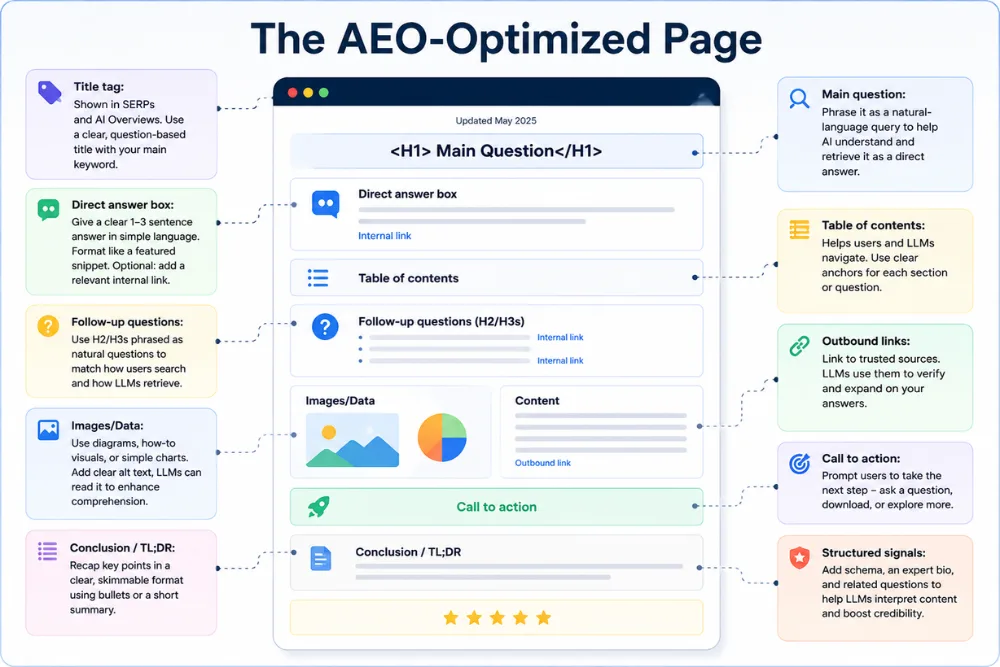
The information provided suggests that structured content, including headers, lists, and bullet points, can support machine readability. However, the most important principle is clarity. Content should make it easy to identify the question being answered and the information that responds to it.
Traditional search usually requires an interaction between the user and a search results page. A person searches for something, receives a selection of ranked webpages, and chooses one to visit.
AEO is connected to a different type of interaction. AI powered systems can provide an answer directly within the response. In many cases, the user may not need to visit a webpage at all.
This is closely connected to zero click searches. Users can receive the information they want without clicking through to a website.
For businesses and publishers, this means online visibility can no longer be considered only in terms of website visits. Being selected or cited within an AI generated response can also become an important form of visibility.
SEO and AEO also differ in how success can be evaluated. Traditional SEO commonly looks at rankings, organic traffic, and click through rates.
AEO focuses more on how frequently content is selected, cited, or used within AI generated answers and voice responses. Brand awareness and credibility can become especially important because users may encounter a brand through an AI response rather than by directly visiting its website.
This does not mean traditional SEO measurements become irrelevant. Instead, the rise of AEO adds another layer to how digital visibility can be understood.
AEO also has a strong connection with voice search. Voice assistants such as Siri and Alexa are designed to understand natural language questions and provide useful responses.
This creates an opportunity for content that is structured around clear questions and direct answers. Content that communicates information naturally and clearly can be easier for AI systems and voice assistants to interpret.
As users increasingly interact with technology through natural language, understanding the way people ask questions becomes increasingly important for digital content strategies.
AEO should not be viewed as a replacement for traditional SEO. Instead, it represents an evolution that complements existing SEO strategies.
SEO provides the foundation for making content discoverable through traditional search engines. AEO adds another focus by helping ensure that the information is understandable and usable by AI powered answer engines.
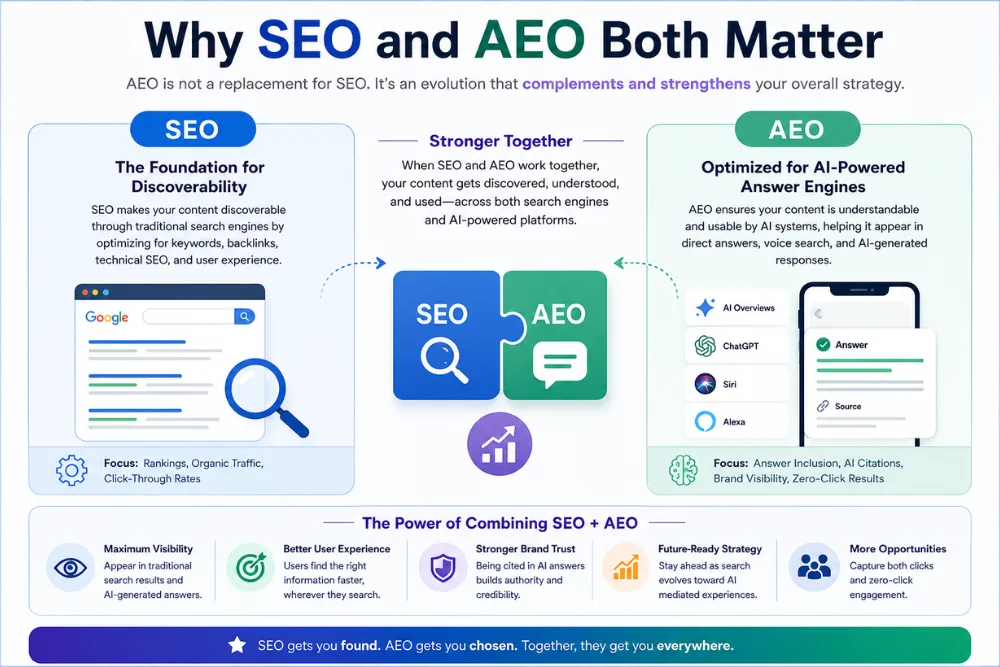
Using both approaches can help brands improve their visibility across traditional search results and AI driven answer formats. A strong SEO strategy can support discoverability, while AEO can help content become more useful within direct answers and AI generated responses.
This combined approach is becoming increasingly relevant as search continues to move toward AI mediated experiences.
| Factor | Traditional SEO | Answer Engine Optimization (AEO) |
|---|---|---|
| Goal | Focuses on improving search engine rankings and increasing organic traffic through keywords, backlinks, technical SEO, and user engagement. | Focuses on getting content selected as a direct answer by AI systems, prioritizing answer inclusion rather than ranking position alone. |
| User Interaction | Users typically find content by clicking ranked links in search results and visiting webpages. | Users can receive instant answers from AI powered systems, often without visiting a webpage, creating zero click search experiences. |
| Content Structure | Focuses primarily on keyword relevance, backlinks, and content optimization for search engine algorithms. | Uses semantically structured and clearly organized content with concise answers that AI systems can easily understand and process. |
| Visibility Metrics | Success is commonly measured through rankings, organic traffic, and click through rates. | Success can be measured through how often content is cited or used in AI generated answers and voice responses, along with brand awareness and credibility. |
| Technological Adaptation | Traditional SEO developed around keyword based search engines and conventional search algorithms. | AEO adapts content for AI driven search systems that use natural language processing and machine learning to determine which information is surfaced as answers. |
Search behavior is changing as AI systems become increasingly involved in how people find information. Instead of always browsing through multiple results, users can ask a question in natural language and receive an immediate response.
This creates a different environment for publishers, businesses, and digital marketers. Content needs to be created not only for search engine rankings but also for clear interpretation by systems that generate answers.
The information provided describes this as a shift toward AI mediated and zero click search experiences in 2026 and beyond. As this shift continues, understanding AEO can help businesses think about visibility in a broader way.
Although AEO focuses heavily on AI systems, the underlying principles are also useful for human readers. Clear explanations, logical structure, concise answers, and meaningful context make content easier for people to understand as well.
The objective should therefore not be to create content exclusively for machines. Instead, the focus should be on creating useful information that communicates its meaning clearly.
When content is easy for people to understand and easy for AI systems to interpret, it can potentially serve both traditional search and AI driven answer experiences.
Answer Engine Optimization is becoming an important part of the changing search landscape. Traditional SEO focuses primarily on improving rankings, attracting organic traffic, and encouraging users to click through to webpages. AEO focuses on helping AI powered systems understand content and use it as a direct answer.
The two strategies are not competitors. SEO remains important for discoverability, while AEO expands the focus toward AI generated answers, voice search, featured snippets, and zero click experiences. As search continues to evolve, combining traditional SEO with AEO can help brands remain visible, understandable, and credible across both conventional search and AI powered answer environments.
References:
SEO vs. AEO: What’s the difference and why it matters
How Is Answer Engine Optimization Different from Traditional SEO?
Answer Engine Optimization is a strategy that focuses on making content easy for AI powered answer engines to understand, select, and present as direct answers to user questions.
SEO focuses mainly on improving webpage rankings and attracting organic clicks, while AEO focuses on making content suitable for selection as a direct answer by AI systems.
No. AEO is not a replacement for SEO. It complements traditional SEO by helping content work effectively in AI driven search experiences.
Clear structure helps AI systems interpret information more easily. Headings, structured content, schema markup, entity based optimization, and conversational formatting can support machine understanding.
AEO success can be evaluated by how often content is cited or used in AI generated answers and voice responses, along with its impact on brand awareness and credibility.
Yes. AEO is relevant to voice search because systems such as Siri and Alexa rely on natural language understanding to provide direct answers to user questions.
SEO helps make content discoverable through traditional search engines, while AEO focuses on helping AI systems understand and use that content in direct answers. Using both can improve visibility across different search experiences.