
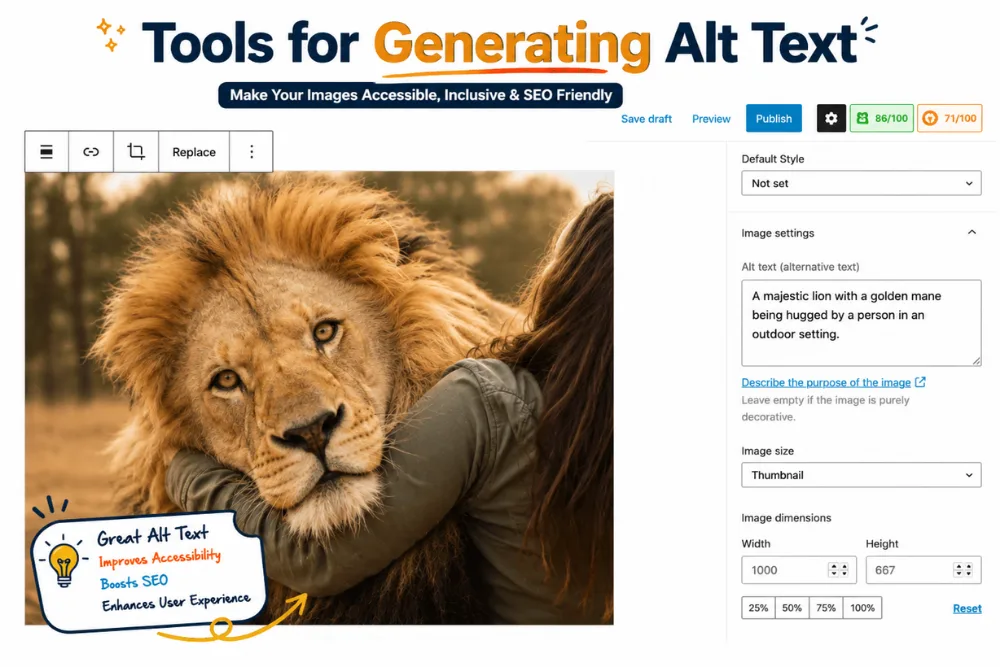
If you are looking for the best tools for generating alt text for SEO, AltText.ai, AutoAlt.ai, and ShortPixel Image Optimizer are among the strongest options to consider. These tools use AI to understand images and create descriptive alt text while supporting accessibility, SEO, content context, and integrations with popular websites and ecommerce platforms.
Images are an important part of modern websites. Whether you run a blog, an online store, a business website, or a large content site, images can make your pages easier to understand and more engaging for visitors. However, simply uploading an image is not enough. You also need to think about how that image is described for people who use screen readers and for search engines that need additional information to understand what an image represents.
This is where alt text becomes important.
Writing alt text manually can become difficult when a website contains hundreds or even thousands of images. It can take a significant amount of time to open every page, inspect every image, understand its context, and then write a useful description. AI powered alt text generators can make this process much easier.
The right tool can analyse an image, understand what appears in it, consider the surrounding page content, and create a description that is useful for accessibility and SEO. Some tools can also automatically add alt text to images across a website, which can be particularly useful for large websites and ecommerce stores.
But not every tool works in exactly the same way. Some focus strongly on accessibility, some provide extensive platform integrations, and others combine alt text generation with image optimization.
So, which tools should you consider when your goal is to create better alt text for SEO?
Alt text is the text used to describe an image. It provides useful information about the image when the image cannot be understood visually. This makes alt text especially important for accessibility because screen readers can use the description to communicate the purpose or meaning of an image to users.
At the same time, descriptive alt text can also provide useful information to search engines says a leading seo expert. Search engines need to understand the content of images, and clear descriptions can help provide additional context about what an image represents.
This means good alt text can support both accessibility and SEO.
However, the purpose of alt text should not simply be to insert keywords into every image. The description should accurately explain what the image conveys and why it is relevant to the page. When you focus on creating useful descriptions for people first, you can also create better information for search engines.
This is why choosing a good AI tool matters.
A strong alt text generator should not simply look at an image and produce a random description. It should ideally understand the image and, where possible, consider the context surrounding that image on the page.
For example, a tool that combines AI image recognition with page context can create alt text that is more relevant to the actual content. This can make the description more useful than a generic description based only on what the AI sees inside the image.
AltText.ai is one of the notable options for generating alt text for SEO and accessibility. The tool is designed to automatically scan a website for missing alt text and generate descriptions for images.
One of the biggest advantages of AltText.ai is its focus on creating descriptions that are both accessibility friendly and useful for SEO. Instead of requiring you to manually write every image description, the tool can automatically generate descriptions that help communicate what images represent.
AltText.ai also supports more than 130 languages. This can be particularly useful for websites that publish content for audiences in different countries or operate multilingual websites.
Another important feature is its integration with popular website and ecommerce platforms. The tool supports platforms such as WordPress, Shopify, WooCommerce, and Magento.
This makes it useful for a wide variety of websites.
For a small website, manually checking image alt text may be manageable. But as the number of pages and images increases, the process becomes much more difficult. A tool that can automatically scan a website for missing alt text can save considerable time.
For ecommerce websites, this can be especially useful because product pages often contain multiple images. A store may have hundreds or even thousands of products, and each product can have several images. Creating descriptions manually for every image can become a large task.
AltText.ai is designed to make that process easier by automatically generating descriptions.
Its focus on accessibility also makes it relevant for website owners who want to improve the experience for visitors who rely on screen readers. The generated descriptions are intended to be clear and descriptive rather than simply containing search keywords.
When your goal is to combine accessibility and SEO while automating the process, AltText.ai is an option worth considering.
AutoAlt.ai is another AI powered tool designed to generate high quality alt text. It provides native plugins for multiple platforms, including WordPress and Shopify.
One of the important aspects of AutoAlt.ai is that it writes real, indexable alt text directly into the HTML. This is important because the alt text needs to exist as actual information on the webpage if it is going to provide value for SEO and accessibility.
The tool also supports multiple languages and is designed to comply with accessibility standards.
Another feature that makes AutoAlt.ai interesting is its AI vision capability. AI vision allows the system to analyse images and understand the visual content before creating the description.
This is important because useful alt text should describe what is actually present in the image. A description that does not accurately represent the image is not helpful to visitors and does not provide the type of meaningful context that good alt text should provide.
AutoAlt.ai is also noted for pricing transparency. This can be useful when deciding which tool is appropriate for a website, especially for businesses managing large numbers of images.
For large scale websites and ecommerce stores, automation can make a major difference. Instead of manually checking every image, a tool can assist with generating descriptions across a large collection of images.
AutoAlt.ai therefore provides a combination of AI image understanding, platform integration, accessibility support, multilingual capabilities, and scalable alt text generation.
If you manage a WordPress or Shopify website and need a tool that can help generate indexable alt text directly on your pages, AutoAlt.ai is another strong option.
ShortPixel Image Optimizer takes a slightly broader approach because it combines image optimization with AI powered alt text generation.
The tool can generate alt text by considering image recognition and the context of the page. This is an important feature because the meaning of an image can depend heavily on the content surrounding it.
An image by itself may have several possible interpretations. However, the surrounding page can provide additional information that helps explain why the image is being used.
By considering both image recognition and page context, ShortPixel can create alt text that is more relevant to the content.
This can be particularly helpful for SEO because the description is connected more closely to the page where the image appears.
Another useful feature is bulk processing. If a website already contains a large number of images, processing them one at a time can be time consuming. Bulk processing makes it possible to handle multiple images more efficiently.
ShortPixel also supports automatic generation for new uploads. This can help websites maintain better alt text practices as new images are added.
Imagine a website where new images are uploaded regularly. Without automation, someone needs to remember to add appropriate alt text every time a new image is uploaded. If that process is forgotten, the website can gradually accumulate images without useful descriptions.
Automatic generation can help reduce that problem.
For website owners who want image optimization and AI powered alt text generation in one tool, ShortPixel Image Optimizer can be a useful choice.
Alt Magic is another AI vision based alt text generator that is particularly relevant to ecommerce websites.
It integrates with WooCommerce and Shopify, making it suitable for online stores that need to create descriptions for product images.
Ecommerce websites often have a large number of images. Product listings may contain several images showing different views of the same product. When a store has hundreds or thousands of products, manually creating alt text for every image can become difficult.
Alt Magic is designed to help automate this process.
One of its useful features is flexibility around keyword inclusion. This can be helpful when you want alt text to naturally include relevant SEO terms where they make sense.
However, keyword inclusion should always remain natural. Alt text should describe the image rather than becoming a collection of search keywords.
Alt Magic also provides tone adjustment. This gives users more flexibility when generating descriptions and can help align the output with the needs of the website.
For ecommerce stores using WooCommerce or Shopify, this combination of AI image understanding, keyword flexibility, tone adjustment, and platform integration can make Alt Magic a practical option.
AI alt text tools can make SEO work easier because they reduce the amount of manual effort involved in creating image descriptions.
A website can contain a large number of images, and each image needs to be considered individually. Manually writing alt text requires time and attention. When this task is repeated across a large website, it can become difficult to maintain consistency.
AI tools can help automate the process.
They can analyse an image, identify the elements within it, and generate a description. Some tools can also consider the context of the page before creating the description.
This combination can produce alt text that is more relevant to the actual content.
The SEO value comes from creating useful, descriptive information rather than simply inserting keywords.
For example, if a website contains an image that is directly connected to the subject discussed on the page, a descriptive alt text can provide additional context about that image.
The key is relevance.
Good alt text should explain what the image conveys. It should not be written solely for search engines. When you focus on accessibility and accurate descriptions, the resulting alt text can also provide useful information for SEO.
This is why AI tools that combine image recognition and contextual understanding can be particularly valuable.
One of the most useful features to look for in an AI alt text generator is the ability to understand page context.
An image does not always communicate its complete meaning on its own.
The same image could be used on different pages for completely different reasons. The surrounding heading, paragraph, product information, or other content can explain why the image matters.
When a tool considers the page context, it has more information available when creating the description.
ShortPixel Image Optimizer, for example, uses image recognition together with page context. This can help create descriptions that are more relevant to the content surrounding the image.
Context can also help prevent descriptions from becoming too generic.
If an AI system only looks at an image, it may describe the visible objects without understanding their importance to the page. When the system considers the page, it has a better opportunity to create a description that connects the image with the content.
For SEO purposes, this relevance is important.
The goal is not to make alt text complicated. The goal is to make it accurate and useful.
When choosing a tool for generating alt text for SEO, there are several important features to consider.
AI image recognition is one of the most important. The tool should be able to understand what is shown in an image and produce an accurate description.
Contextual page data is another valuable feature. When the tool can consider the content surrounding an image, it can create descriptions that are more relevant to the page.
Platform integration is also important. If you use WordPress, Shopify, WooCommerce, or Magento, choosing a tool that integrates directly with your platform can make the process much easier.
Bulk processing is another feature worth considering for large websites. If you have many existing images, generating descriptions individually can take a lot of time.
Automatic generation for new uploads can also be useful. This allows alt text generation to become part of the ongoing image management process instead of being something you have to remember manually each time.
Keyword flexibility is another consideration. A good tool should allow relevant keywords to be included naturally without encouraging keyword stuffing.
Accessibility compliance should also be considered. Alt text exists primarily to improve accessibility, so the tool should support descriptions that are useful for people who use screen readers.
Alt text should generally be concise. A useful guideline is to keep it between 5 and 15 words.
| Alt Text Best Practice | What to Do |
|---|---|
| Keep it concise | Avoid writing a long paragraph describing every visible detail in the image. |
| Focus on important information | Describe the main subject or information the image conveys. |
| Be accurate | Make sure the alt text correctly represents what is shown in the image. |
| Keep it natural | Write alt text in clear, natural language that is easy to understand. |
| Use keywords naturally | Include an SEO keyword only when it accurately describes the image and fits naturally. |
| Avoid keyword stuffing | Do not add unrelated or excessive keywords simply to target search terms. |
| Prioritize accessibility | Write alt text primarily to help users understand the image, especially those using screen readers. |
| Ask the key question | Before publishing, ask, “Does this alt text accurately describe what the image conveys?” |
Keyword stuffing is one of the easiest mistakes to make when creating alt text for SEO.
Because alt text can provide information to search engines, some website owners may try to add multiple keywords to every image. This can result in descriptions that sound unnatural and do not accurately describe the image.
That defeats the main purpose of alt text.
The primary goal should be accessibility.
Alt text should help someone understand what an image represents when they cannot see it. SEO should be considered as part of the overall benefit, but it should not replace the need for an accurate description.
AI tools can help with this process, but the generated text should still be reviewed when necessary.
A useful alt text description should feel like something a person would naturally write when explaining an image to another person.
That is a much better approach than trying to turn the alt text field into a list of keywords.
Accessibility is one of the most important reasons to use alt text.
People who use screen readers may not be able to see images in the same way as other visitors. Alt text provides additional information that can help them understand the image.
This means accessibility should remain the priority when creating alt text.
An SEO focused approach that ignores accessibility misses an important part of what alt text is supposed to accomplish.
AI powered tools can help because they can automatically generate descriptions at scale. Tools such as AltText.ai, AutoAlt.ai, ShortPixel Image Optimizer, and Alt Magic are designed to help websites create descriptive alt text more efficiently.
The best approach is to use these tools as a way to make the process easier while keeping the descriptions accurate, relevant, and accessible.
When accessibility improves, the overall quality of the website experience can improve as well.
The best alt text generator depends on what type of website you manage and what you need from the tool.
If your priority is automatic scanning for missing alt text, multilingual support, and integration with several popular platforms, AltText.ai is a strong option to consider.
If you are looking for AI generated alt text with native plugins, indexable text written directly into HTML, multilingual support, and strong AI vision capabilities, AutoAlt.ai may be suitable.
If you want to combine image optimization with AI powered alt text generation, ShortPixel Image Optimizer provides that combination. Its ability to consider page context, process images in bulk, and generate alt text for new uploads can be useful for larger websites.
If you operate an ecommerce store using WooCommerce or Shopify and want flexibility around keyword inclusion and tone, Alt Magic may be worth considering.
There is no single tool that is automatically the best for every website.
The right choice depends on your platform, image volume, language requirements, accessibility needs, and desired level of automation.
The larger a website becomes, the more difficult manual image management can become.
A small website may only have a few dozen images. Writing alt text for those images may be manageable.
A large website can have hundreds or thousands of images.
Ecommerce stores can face an even bigger challenge because every product may have multiple images.
When image numbers grow, manual work becomes increasingly time consuming.
Automation can solve much of this problem.
AI powered tools can scan websites, identify missing alt text, analyse images, and generate descriptions. Some can process existing images in bulk, while others can automatically create alt text when new images are uploaded.
This makes it easier to maintain consistent image descriptions over time.
Automation does not mean you should stop caring about quality. Instead, it gives you a faster starting point and reduces repetitive work.
You can then review important images where necessary.
For large websites, this can make alt text management far more practical.
Ecommerce websites are particularly well suited to AI alt text generation.
An online store can contain a huge number of product images. Each image may show a product from a different angle or highlight a particular feature.
Creating useful descriptions for all of these images manually can require a lot of time.
Tools that integrate directly with WooCommerce and Shopify can simplify the process.
AltText.ai supports WooCommerce and Shopify, while Alt Magic is also designed to work with WooCommerce and Shopify. AutoAlt.ai provides integrations for platforms including WordPress and Shopify.
This platform support makes these tools especially useful for ecommerce businesses.
When product images have appropriate descriptions, the website can provide better information for visitors who rely on screen readers while also giving search engines additional context.
The key is still accuracy.
A generated description should reflect what is actually shown in the product image.
Good alt text should sound natural. This may seem obvious, but it becomes particularly important when SEO keywords are involved. A description should not feel like it was written only to influence search rankings.
Instead, imagine that you are describing the image to someone who cannot see it.
What would you say? That mindset can help produce better alt text. AI tools can generate descriptions quickly, but natural language remains important. Keyword inclusion should happen naturally when appropriate, rather than being forced into every description.
This is especially important for websites that use large numbers of images. If every image contains awkward keyword combinations, the alt text becomes less useful and less accessible. A concise, accurate, natural description is a much better approach.
Search engines need information to understand images. While visual recognition can help systems understand what an image contains, descriptive alt text can provide additional information about the image and its relationship to the page.
This is why alt text can be part of a broader SEO strategy. The goal is not simply to make an image rank. Instead, the goal is to make the image and the surrounding page easier for search engines to understand.
When an image description accurately reflects the visual content and the page context, it can contribute to a clearer understanding of the page. AI tools can make this process easier by combining image recognition with contextual information. That is one of the main reasons AI powered alt text generators have become useful for modern websites.
Choosing the right tool for generating alt text for SEO can make image management much easier, especially when your website contains a large number of images. AltText.ai, AutoAlt.ai, ShortPixel Image Optimizer, and Alt Magic each provide useful capabilities for creating descriptive alt text with AI.
AltText.ai stands out for automatic website scanning, support for more than 130 languages, accessibility focused descriptions, and integrations with WordPress, Shopify, WooCommerce, and Magento. AutoAlt.ai provides AI generated alt text, native plugins, multilingual support, accessibility compliance, and real indexable alt text directly in HTML.
ShortPixel Image Optimizer combines image optimization with AI powered alt text generation and can consider both image recognition and page context. Its bulk processing and automatic generation for new uploads can be particularly useful for larger websites. Alt Magic provides AI vision based generation with WooCommerce and Shopify integrations, along with flexibility around keyword inclusion and tone adjustment.
Regardless of which tool you choose, the basic principles remain the same. Alt text should be concise, accurate, descriptive, and useful. A general guideline is to keep it between 5 and 15 words. Avoid keyword stuffing and focus primarily on accessibility.
When you approach alt text this way, SEO becomes a natural part of the process rather than the only goal.
AltText.ai, AutoAlt.ai, and ShortPixel Image Optimizer are among the best options provided in this comparison. Each combines AI image analysis with features designed to support accessibility and SEO.
Alt text should generally be concise, with a typical guideline of 5 to 15 words. The description should focus on accurately explaining what the image conveys.
Relevant SEO keywords can be included naturally when they accurately describe the image. Keyword stuffing should be avoided because alt text should remain useful and descriptive.
AltText.ai supports more than 130 languages. AutoAlt.ai also supports multiple languages.
AltText.ai supports Shopify and WooCommerce, AutoAlt.ai supports Shopify, and Alt Magic integrates with WooCommerce and Shopify.
Alt text helps provide image information to people who use screen readers. Accessibility should be the primary purpose of alt text, while SEO can benefit from accurate and descriptive image information.
Yes. AI powered tools can analyse images and generate descriptions automatically. Some tools can also scan websites for missing alt text, process images in bulk, and generate alt text for new uploads.
Look for accurate AI image recognition, contextual page understanding, CMS and ecommerce integrations, bulk processing, automatic generation for new uploads, natural keyword inclusion, and accessibility compliance.
AI generated alt text can support SEO when it accurately describes the image and is relevant to the surrounding page content. The focus should remain on clear, descriptive, and accessible language.
AltText.ai, AutoAlt.ai, and ShortPixel Image Optimizer can be useful for large websites because they provide automation features. Bulk processing and automatic generation can reduce the manual effort required to manage many images.