
Yes, a premium AI chatbot service can absolutely be worth the cost, but only if you actually use it enough to justify the price. If you chat with AI a few times a week for quick questions, the free version will probably do just fine. If you rely on it daily for work, writing, or coding, the upgrade tends to pay for itself pretty quickly.
I know that answer sounds like a dodge, but stick with me, because the real answer depends on a few things that most articles gloss over. Honestly, that’s the best way to actually understand whether you should pull out your card for one of these subscriptions.
Here’s the thing that surprises a lot of people. The free versions of tools like ChatGPT and Google Gemini are genuinely good. Like, really good. You can ask questions, get help drafting an email, brainstorm ideas, and even generate a few images without spending a single penny. For most casual users, that free tier covers ninety percent of what they’d ever want to do with AI.
So why would anyone pay? Well, the premium plans usually unlock access to smarter, more capable models that reason through complex problems more carefully. Think of it like the difference between asking a smart friend a quick question versus asking a specialist who takes their time to actually think it through before answering. Premium tiers also tend to come with faster response times, priority access when everyone else is getting stuck in a queue during busy hours, and extra features like deeper customisation, longer conversations, and the ability to upload and analyse more files.
Casual users who just want quick answers or a bit of help drafting a text message probably won’t notice much of a difference between free and paid. But if you’re someone who pushes these tools hard, asking them to write long documents, debug code, or work through multi step problems, you’ll start hitting the limits of the free tier pretty fast. That’s usually the moment people start seriously considering whether to pay.
Numbers help clear things up, so let’s actually look at what these subscriptions cost and what you get for your money, since the pricing can be surprisingly confusing once you factor in currency conversions and taxes.
| AI Subscription Plan | USD Price | Approx. AUD Price | Core Benefits |
|---|---|---|---|
| ChatGPT Go | $8/month | A$11.20/month | Unlimited everyday text chats, limited file uploads |
| Google AI Plus | $4.99/month | A$7.00/month | 400GB storage, Gemini access |
| ChatGPT Plus | $20/month | A$28.00/month | Advanced models, file analysis and additional features |
| Claude Pro | $20/month | A$28.00/month | Claude Code, Projects, writing and coding tools |
| Google AI Pro | $19.99/month | A$28.00/month | Gemini, Google apps integration and cloud storage |
Looking at these numbers side by side, you can see there isn’t a single “best” price. It really comes down to matching the plan to how you actually use these tools day to day, and whether the extra features attached to each one are things you’d genuinely use rather than nice sounding add ons you’ll forget about within a week.
Know more: AI Chatbot Pricing Breakdown
Let’s be real with each other for a second. Not everyone needs a premium AI subscription, and honestly, plenty of people who pay for one probably don’t need it either. So who actually gets their money’s worth?
Developers and researchers tend to see the clearest return on investment. If you’re writing code all day, a premium plan with advanced reasoning models and higher usage limits can genuinely save hours each week by catching bugs faster, explaining tricky concepts, and helping you write cleaner code the first time around. When your time is worth real money, saving even thirty minutes a day adds up fast.
Writers, marketers, and content creators are another group that tends to benefit heavily, especially if you’re producing large volumes of work or need help maintaining a consistent tone across many pieces. The ability to upload longer documents, keep context across a project, and get more thoughtful, nuanced responses makes a real difference when you’re not just asking one off questions but actually building something over time.
Students and lifelong learners can also get a lot out of premium plans, particularly when working through complex subjects that require the AI to actually reason through multiple steps rather than give a surface level answer. That said, plenty of students do perfectly fine with free tiers, especially if their coursework doesn’t demand heavy, sustained use.
If you’re someone who opens up an AI chatbot once or twice a week to settle a debate with a friend, get a recipe idea, or write a quick birthday message, you’re probably not going to notice enough of a difference to justify a monthly bill. And that’s completely fine. There’s no shame in sticking with free tools if they already meet your needs.
It’s also worth remembering that AI tools are evolving at a genuinely wild pace. Features that are locked behind a paywall today have a real chance of becoming standard and free within a year or two, simply because competition between these companies keeps pushing free tiers to get better and better.
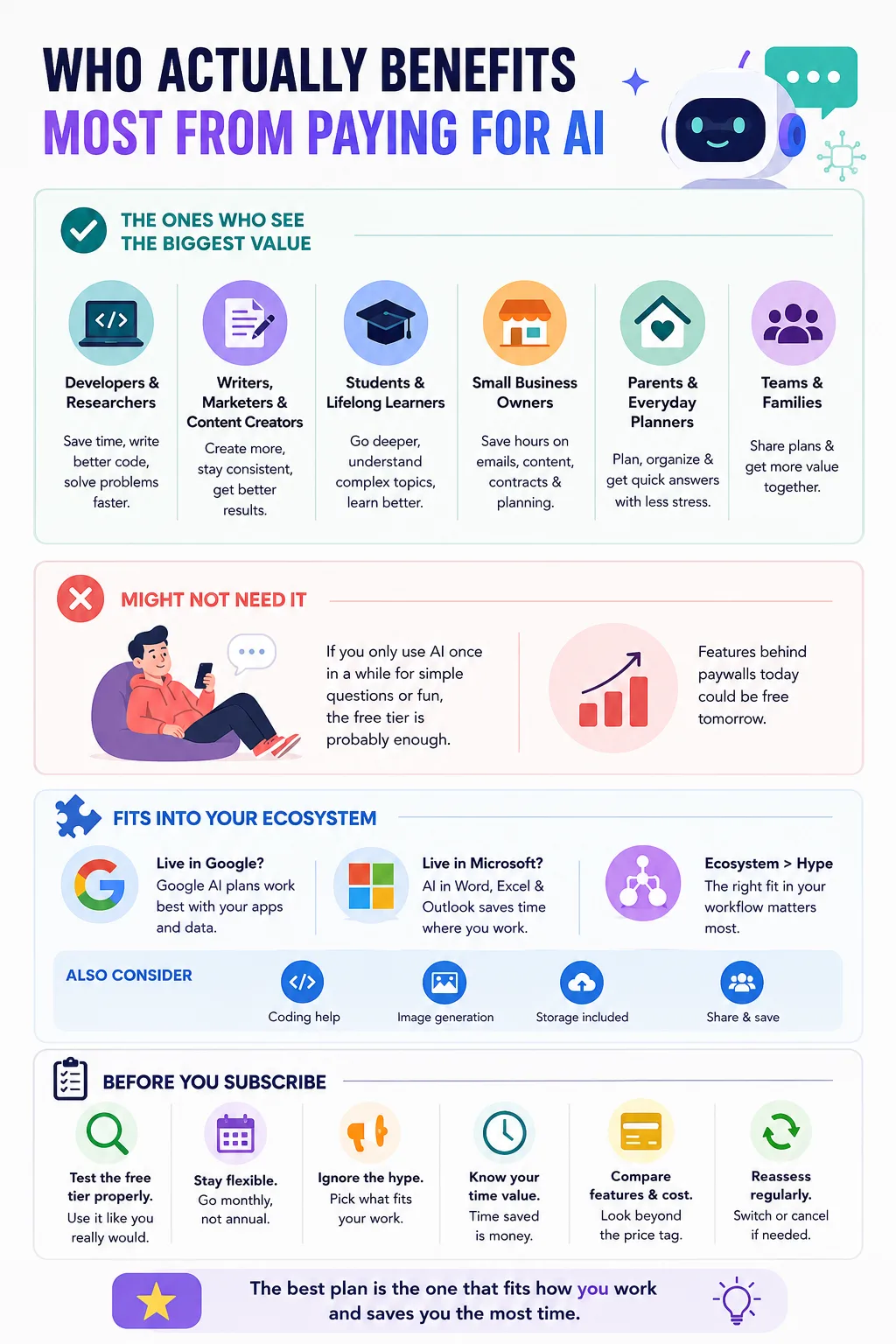
Small business owners are another group worth mentioning here, even though they often get left out of these conversations. If you’re running a shop, a freelance practice, or a small team, a premium AI subscription can quietly take over a surprising number of tasks that used to eat up your evenings. Drafting customer emails or putting together a quick marketing plan are all things a capable AI model can help with directly. When you weigh that against hiring extra help or spending your own limited hours on it, the monthly subscription cost often starts to look pretty small in comparison.
Parents and everyday planners shouldn’t be overlooked either. Plenty of people use AI chatbots to help plan meals, organise a household budget, draft a tricky message to a school or landlord, or just get quick, reliable answers to random questions that pop up during a busy week. For this kind of use, the free tier is usually more than enough, but if you find yourself leaning on the tool multiple times a day, a modestly priced plan like ChatGPT Go or Google AI Plus can smooth out those little frustrations of hitting a daily limit right when you need help the most.
Also read: Claude vs ChatGPT vs Gemini: Which AI Chatbot Is Right for You?
One thing that doesn’t get talked about enough is how much these subscriptions can matter based on what ecosystem you’re already living in. If your entire digital life runs through Google, from your email to your calendar to your documents, then something like Google One AI Premium starts to make a lot more sense than it would for someone who barely touches Google products.
The same logic applies if your workplace runs on Microsoft 365. A premium AI add on that plugs directly into Word, Excel, and Outlook can feel almost seamless, because the AI is working right where you already spend your day rather than forcing you to copy and paste between different windows and tabs.
This ecosystem factor matters just as much, if not more, than raw model quality for a lot of people. An AI model that’s slightly more advanced isn’t very useful if it lives in an app you never open, while a slightly less flashy model that’s built directly into your existing workflow might save you far more time simply because it’s right there when you need it.
It’s also worth considering features for your needs. Choose features that match your specific use case. If you need coding help, check coding assistance. Do not rely only on general chat features. Compare image generation features if they matter. Quality and limits can vary between providers.
Storage is another important factor to consider. People often overlook storage when comparing AI plans. Some subscriptions include substantial cloud storage. Google One AI Premium includes two terabytes. This effectively combines two services into one. That can improve the subscription’s overall value. You may otherwise pay separately for extra storage. Bundled storage becomes useful when space runs low. This includes email and photo storage needs. Storage could influence your final subscription choice. Consider storage before comparing AI capabilities alone.
It also helps to think about how many people in your household or team might end up using the same subscription. Some plans allow a bit of sharing or multiple seats under one billing account, which can meaningfully change the cost per person and make an otherwise pricier plan feel a lot more reasonable once it’s split a few ways.
Before you commit your card details to a monthly subscription, it’s worth slowing down for a moment and actually testing the free tier properly first. So many people jump straight to paying because a friend recommended a tool, without ever really pushing the free version to its limits to see if it was already enough for their needs.
Give the free version a genuine trial for a week or two, using it the same way you would if you were paying for it. Ask it the kinds of questions you’d normally ask, use it for the kinds of tasks you’d actually need help with, and pay attention to where it starts to fall short. That’s the real test, not just a quick five minute play around.
It’s also smart to avoid locking yourself into long term commitments right now, simply because this entire industry is moving incredibly fast. Prices shift, new models get released, and features that seem cutting edge today might be replaced by something better within months. Sticking to monthly billing rather than annual plans gives you the flexibility to switch or cancel without losing much if a better option comes along.
Try not to get swept up chasing whatever tool is trending at the moment either. The AI space has a lot of hype, and it’s easy to feel like you need the newest, shiniest model everyone’s talking about online. But the tool that’s genuinely best for you is the one that fits how you actually work, not necessarily the one making headlines this week.
Finally, take a moment to actually calculate what your time is worth versus what the subscription costs. If a premium plan genuinely saves you even an hour or two a week, and your time is valuable to you, the maths on that usually works out pretty favourably in the subscription’s favour.
So, is a premium AI chatbot subscription worth it? Honestly, for me, Dony Garvasis, it comes down to how seriously I rely on AI in my daily life. If you’re using it for real productivity, creative projects, coding, or serious learning, a paid plan tends to unlock enough extra capability and reliability to be genuinely worth the monthly cost. You get smarter models, fewer limits, and features that actually save you time rather than just feeling like a nice extra.
If you’re a casual user who dips in occasionally for quick help, you can probably hold off for now and stick with the free version while keeping an eye on how these premium features evolve, since many of them do eventually trickle down to free tiers anyway. There’s no universal right answer here, only the answer that fits your own habits, your own budget, and how much value you personally get out of leaning on AI throughout your week.
Whatever you decide, the smartest move is always to test before you buy, pay attention to how the tool fits into your existing routine, and choose based on your actual needs rather than what everyone else online seems to be raving about.
It depends on how often you chat and what you need from it. If you use ChatGPT daily for work, writing, or coding, the advanced models and higher limits usually make it worth the cost. For occasional, casual chatting, the free version is often enough.
Paid plans typically offer smarter reasoning models, faster responses, priority access during busy periods, and extra features like deeper file analysis and more customisation. Free versions still cover most everyday tasks quite well.
Based on current pricing, ChatGPT Go and Google AI Plus sit at the lower end, making them accessible starting points for people.
Some students benefit greatly, especially those tackling complex subjects that require step by step reasoning. Others do perfectly fine with free tiers. It really depends on your course load and how heavily you rely on AI for studying.
Most providers offer monthly billing that you can cancel whenever you like, which is generally the safer choice given how quickly pricing and features change in this space. Avoid long annual commitments unless you’re already confident the tool fits your needs long term.
It’s quite possible. Competition between AI companies is fierce, and features that are locked behind a paywall today.
If your needs change, or a different plan fits your ecosystem or workflow better, switching can absolutely make sense. Just make sure you’re not paying for two overlapping subscriptions at once, and cancel the old one before starting the new plan.