
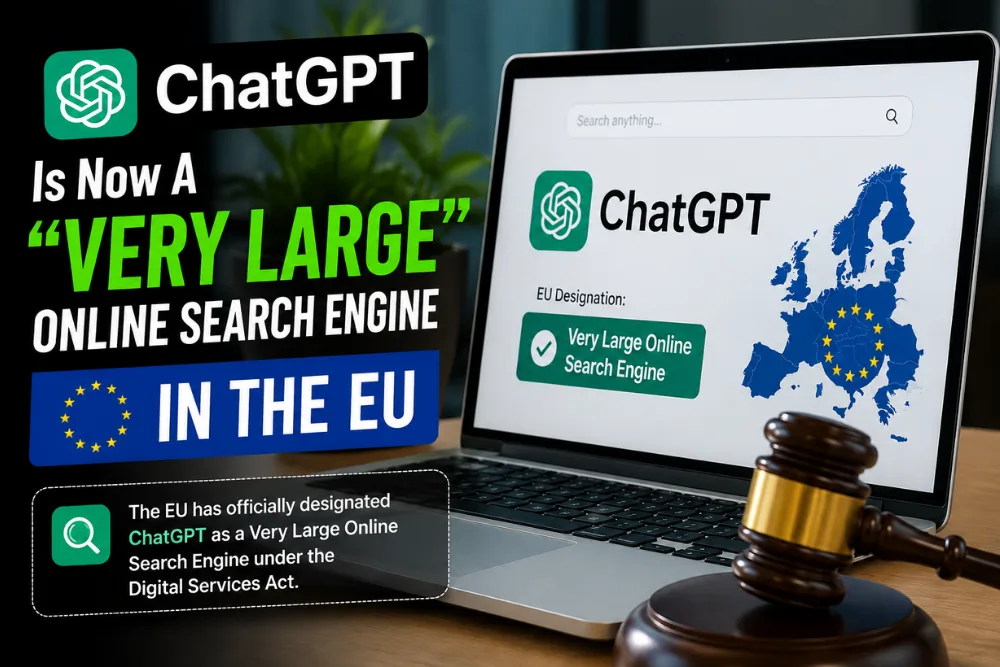
ChatGPT is now officially designated as a “very large online search engine” in the European Union under the Digital Services Act. The European Commission made the designation after OpenAI reported approximately 159.1 million average monthly active recipients for ChatGPT search in the EU, placing the service well above the 45 million threshold.
The European Commission has officially designated ChatGPT as a very large online search engine under the Digital Services Act, marking an important development for how the AI service is treated within the European Union. According to the information provided, ChatGPT is the first AI chatbot to receive this particular designation under the DSA.
The decision means that the European Commission now recognizes ChatGPT not simply as an AI chatbot, but also as a service that qualifies as an online search engine because of the way it handles user questions and searches the web.
This distinction is important because the Digital Services Act applies additional responsibilities to services that reach very large numbers of people in the European Union. The designation therefore places ChatGPT in a category that comes with additional obligations related to scrutiny, accountability, transparency, and systemic risk.
The Commission announced the ChatGPT designation together with two other decisions involving Reddit and Roblox. While ChatGPT was designated as a very large online search engine, Reddit and Roblox were recognized as very large online platforms.
All three services have reached the level of use that brings them into this higher category under the DSA.
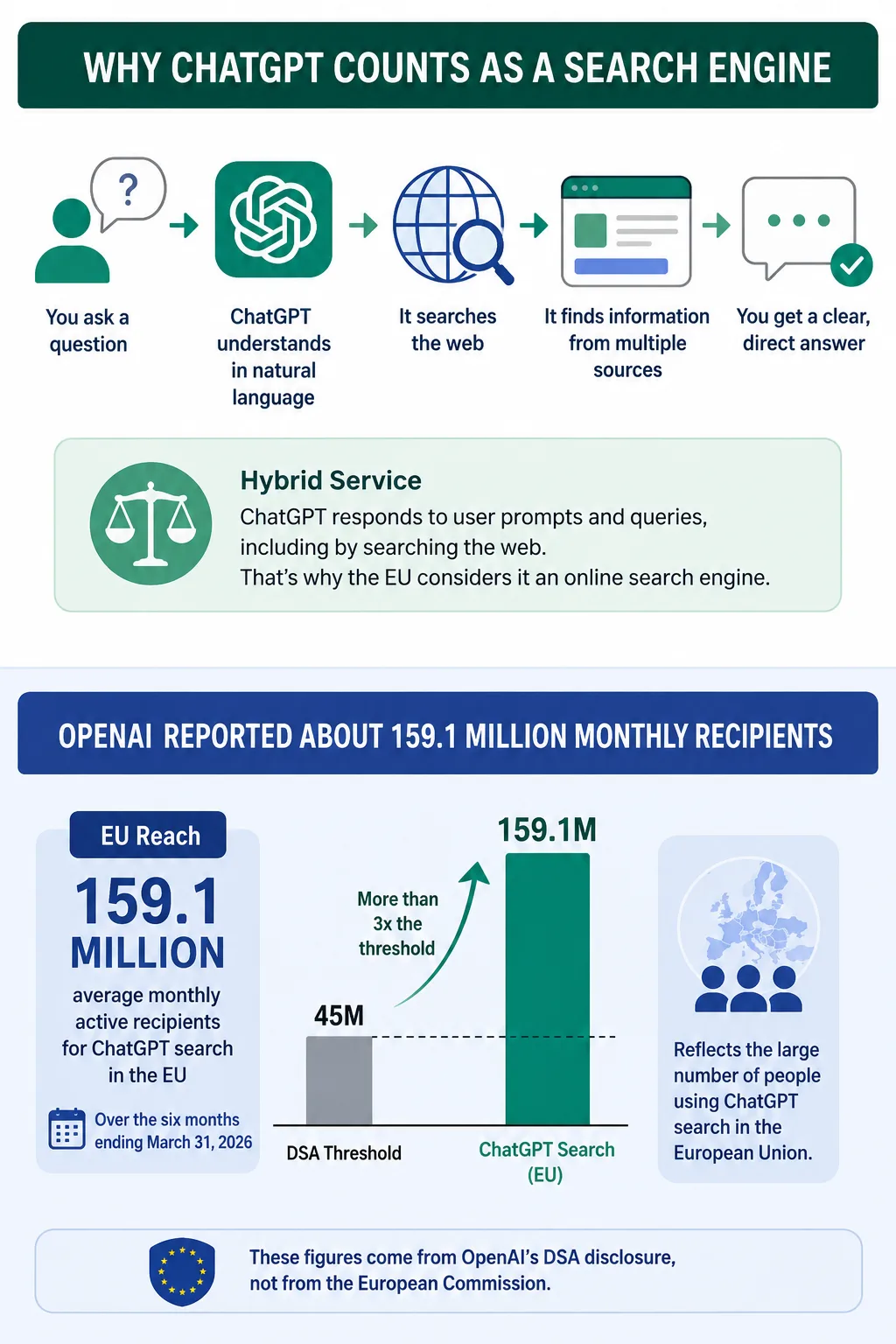
For ChatGPT, the number reported by OpenAI is particularly significant. OpenAI reported approximately 159.1 million average monthly active recipients for ChatGPT search in the European Union over the six months ending March 31, 2026.
That number is substantially higher than the 45 million threshold associated with the designation.
The decision therefore provides a clearer picture of how the European Commission views the growing role of AI powered search services. ChatGPT can respond directly to questions, and it can also search the web when handling prompts and queries. That combination is what makes the service relevant to the online search engine category described by the Commission.
At first glance, calling ChatGPT a search engine might sound unusual. Most people traditionally think of a search engine as a service where users type a query, receive a collection of links, and then choose a website to visit.
ChatGPT works differently in many situations. Users can ask questions in natural language and receive direct answers. The service can also search the web when responding to prompts and queries.
The European Commission described ChatGPT as a hybrid service. According to the information provided, this hybrid nature allows ChatGPT to qualify as an online search engine because it responds to user prompts and queries, including by searching the web.
That description helps explain why the designation is focused on ChatGPT search rather than simply treating every aspect of the chatbot in exactly the same way.
The important point is that ChatGPT is capable of functioning as a way for users to find information. Instead of only producing responses based on its existing capabilities, it can search the web and use information from those searches when responding to users.
That gives it a role that overlaps with traditional online search services.
The European Commission therefore considers the service within the scope of the online search engine definition used for the designation. The decision is not presented as a statement that ChatGPT is identical to a traditional search engine. Instead, it recognizes the hybrid way the service operates.
For users, this distinction may not change how ChatGPT feels on a day to day basis. People can still ask questions, request information, and interact with the chatbot conversationally. However, from a regulatory perspective, the ability to answer queries and search the web becomes particularly important.
This is one of the key reasons the designation matters.
The size of ChatGPT search in the European Union is central to the decision.
OpenAI reported approximately 159.1 million average monthly active recipients for ChatGPT search in the EU over the six months ending March 31, 2026. The figure comes from OpenAI’s own DSA disclosure.
The number is more than three times the 45 million threshold mentioned in the information provided.
That makes the scale of ChatGPT search particularly notable. The European Commission’s designation is therefore connected to the large number of people who are using the service in the European Union.
It is also important to understand what the figure represents. The reported number is the average monthly active recipients for ChatGPT search in the EU over the stated six month period. It is not simply a count of every person who has ever used ChatGPT.
The wording matters because the DSA designation depends on the scale of active use.
The provided information also notes that the individual figures come from the companies’ own DSA disclosures rather than from the European Commission’s release itself.
For ChatGPT, OpenAI supplied the figure of approximately 159.1 million average monthly active recipients.
This gives the public a clearer view of why ChatGPT meets the requirements for the designation. The figure is considerably above the threshold, making the scale of the service difficult to overlook.
It also shows why the European Commission is treating ChatGPT as a service with a large impact on citizens and society.
The designation is therefore not based on the idea that ChatGPT is merely becoming popular. It is tied to the reported number of people using ChatGPT search within the European Union.
The 45 million figure is an important part of understanding the announcement.
According to the information provided, services reaching at least 45 million average monthly users in the European Union can meet the threshold for the relevant very large service designation.
OpenAI’s reported figure for ChatGPT search was approximately 159.1 million average monthly active recipients. That places ChatGPT significantly above the threshold.
The comparison makes the scale of the designation easier to understand.
A service reaching around 45 million average monthly recipients is already considered large enough to fall within the higher level of scrutiny associated with the designation. ChatGPT search, based on OpenAI’s reported figure, reaches a number that is more than three times that level.
This is why the announcement is more than a simple change in terminology.
The designation reflects the scale at which ChatGPT search operates within the European Union. The larger the number of people using a service, the greater the potential impact that service can have on citizens and society.
The information provided also makes clear that designation itself is not a finding of wrongdoing. That distinction is important.
The European Commission’s decision places ChatGPT within a particular regulatory category. It does not mean that the Commission has declared ChatGPT to have violated the law.
Instead, the designation creates additional obligations that the service must meet.
That difference can easily be missed when reading headlines about regulatory decisions. A designation describes the status of a service under the DSA, while enforcement is a separate process.
For ChatGPT, the designation therefore means additional responsibilities rather than an accusation of wrongdoing.
ChatGPT was not the only service included in the European Commission’s announcement.
Reddit and Roblox were also designated, although they received a different classification. The information provided says that Reddit and Roblox are now recognized as very large online platforms.
Both services reached the relevant level of use in the European Union.
Reddit reported no more than 57.2 million monthly users for the first half of 2026. Roblox estimated its average at 46.6 million.
These figures place both services at or above the 45 million threshold described in the provided information.
The three announcements therefore demonstrate how the DSA can apply to different types of major online services.
ChatGPT is classified as a very large online search engine because of its hybrid search capabilities and the way it responds to user queries, including by searching the web.
Reddit and Roblox, meanwhile, are recognized as very large online platforms.
Although the categories are different, the common factor is the large scale of use in the European Union.
The Commission’s decision brings these services under a higher level of scrutiny and accountability.
This is particularly relevant because the Commission has connected the designations to the impact these services can have on citizens and society.
Henna Virkkunen, the Commission’s executive vice president for tech sovereignty, security and democracy, explained the significance of the designations.
She said that ChatGPT, Reddit, and Roblox would now be held to a higher standard of scrutiny and accountability in the European Union, in line with their large impact on citizens and society.
That statement gives useful context for understanding what the designation means.
The focus is not simply on the number of users. The scale of these services also means that their activities can have a wider effect.
ChatGPT is particularly interesting in this regard because it can provide answers directly to users and can search the web while responding to queries.
That makes the service different from a platform where users simply browse or interact with content.
The European Commission’s decision therefore reflects the changing role of online services. AI systems can now perform functions that overlap with traditional internet services, including information discovery and search.
The designation recognizes this changing environment.
It also places greater attention on accountability and transparency. The provided information says that over time, transparency rules could become just as important as the label itself.
That is an important point because the designation is only one part of the broader regulatory picture.
Following the designation, ChatGPT has a four month period to comply with the additional DSA obligations described in the provided information.
The same four month period applies to Reddit and Roblox following their respective designations.
This compliance window gives the services time to meet the requirements that come with their new status.
For ChatGPT, the additional obligations are connected to its designation as a very large online search engine.
The four month period is therefore an important part of what happens next.
The announcement does not mean that every additional obligation begins and is completed immediately on the day of designation. Instead, the service has a defined period to prepare for and comply with the added requirements.
For users, this could eventually mean greater transparency around how the service operates and how systemic risks are identified and addressed.
The provided information specifically highlights several areas that become important under the additional obligations, including systemic risk controls, independent audits, access for regulators and researchers, and recommender and advertising requirements where applicable.
These areas give a clearer idea of what the higher level of responsibility involves.
One of the additional obligations highlighted in the provided information is systemic risk control.
The requirement involves identifying, assessing, and mitigating risks related to the service and its algorithmic systems.
For a service as large as ChatGPT search, this is particularly relevant because the system can influence how people find and receive information.
The obligation is focused on the risks connected with the service and its algorithmic systems.
The key idea is that risks should not simply be ignored after a service becomes widely used. Instead, the service is expected to identify potential systemic risks, assess them, and take steps to mitigate them.
This adds another layer to the discussion around ChatGPT’s designation.
The European Commission is not only recognizing the size of ChatGPT search. It is also requiring the service to operate within a framework that gives greater attention to potential risks associated with large scale use and algorithmic systems.
The information provided does not list specific examples of those risks, so it would be inappropriate to add examples beyond what has been supplied.
What is clear is that identifying, assessing, and mitigating risks connected to the service and its algorithmic systems forms part of the additional obligations.
Another obligation highlighted in the provided information concerns independent audits.
ChatGPT will be required to undergo an independent audit at least once a year and respond to the auditor’s recommendations.
This introduces an external review element into the compliance process.
An annual independent audit means the service will have its relevant obligations reviewed by an independent auditor. The requirement to respond to recommendations also means that the audit is not simply a formal exercise.
The service will need to address the recommendations that come from the auditor.
This is another reason why the designation matters beyond the label itself.
The European Commission’s decision creates a framework in which ChatGPT will face additional scrutiny. Independent audits provide one mechanism for that scrutiny.
For users, the importance of this may not always be visible immediately. However, from a regulatory perspective, independent assessment can help provide a clearer picture of whether the service is meeting the responsibilities associated with its designation.
The information provided specifically says the audit must take place at least once a year.
That establishes an ongoing requirement rather than a single review connected only to the initial designation.
The provided information also highlights regulator and researcher access as an additional obligation.
Under this requirement, data will be shared with the Commission and national authorities. Vetted researchers will also be allowed access for qualifying systemic risk research.
This part of the designation is especially important because it creates a legal avenue for researchers to study systemic risks.
The ability of qualified researchers to access relevant platform data can help support research into the effects and risks associated with large online services.
The information does not provide details about every type of data that could be requested, so the article should not go beyond the supplied material.
What is clear is that the European Commission and national authorities will have a greater role in receiving data, while vetted researchers will have access for qualifying systemic risk research.
This is directly connected to the broader transparency goals associated with the DSA designation.
The provided information suggests that transparency rules could become just as important as the designation itself over time.
That makes researcher access a particularly notable part of what happens next.
The provided information also mentions obligations concerning recommenders and advertising.
Where applicable, the service must offer a recommender option that is not based on profiling and maintain a public ad repository.
These requirements are included among the additional obligations associated with the designation.
The recommender requirement focuses on providing an option that is not based on profiling where applicable.
The public advertising repository requirement is another transparency related measure.
Together, these requirements show that the designation involves more than simply recognizing ChatGPT as a very large service.
The service will have additional responsibilities connected to how recommendations and advertising are handled where those requirements apply.
The information provided does not offer further details about how the recommender option or public advertising repository will operate, so those details should not be assumed.
What can be said is that they form part of the additional obligations identified in the announcement.
This again highlights why the practical consequences of the designation may become more important over time.
One of the most important points in the provided information is that designation is not a finding of wrongdoing.
This distinction deserves attention because regulatory terminology can sometimes sound more serious than it actually is.
The European Commission has designated ChatGPT as a very large online search engine under the DSA. That designation places the service within a regulatory category and creates additional obligations.
It does not mean that the Commission has found ChatGPT guilty of wrongdoing.
The information explicitly states that enforcement is a separate process.
This means readers should not interpret the designation as an enforcement action by itself.
Instead, it is better understood as a recognition that ChatGPT search has reached a scale and performs functions that place it within the relevant category under the DSA.
The service must now meet the additional requirements connected to that category.
That is an important distinction when discussing the announcement.
It also helps explain why the four month compliance window exists. The designation establishes the new status, while the compliance period provides time for the service to meet the added obligations.
The reported figure of approximately 159.1 million average monthly active recipients is perhaps the most striking number in the announcement.
It demonstrates the scale of ChatGPT search in the European Union.
The figure covers the six months ending March 31, 2026, and comes from OpenAI’s DSA disclosure.
When compared with the 45 million threshold, the scale becomes even clearer.
ChatGPT search was reported at more than three times the threshold.
This is significant because the DSA designation is directly connected to the reach of very large services.
The figure also helps explain why the European Commission is applying a higher level of scrutiny and accountability.
ChatGPT has become a major way for users to interact with information. Its ability to respond directly to questions and search the web gives it a role that extends beyond a conventional chatbot.
The 159.1 million figure provides the quantitative context for that role.
It is also important not to confuse the number with a general claim about every ChatGPT user in the world. The figure specifically concerns average monthly active recipients for ChatGPT search in the European Union during the stated six month period.
That distinction keeps the figure in its proper context.
The designation creates a new regulatory phase for ChatGPT in the European Union.
The immediate next step is the four month compliance period.
During this time, ChatGPT must meet the additional DSA obligations associated with its designation.
Those obligations include systemic risk controls, independent audits, access for regulators and qualifying researchers, and recommender and advertising requirements where applicable.
The broader significance is that ChatGPT is now formally recognized by the European Commission as a very large online search engine.
This reflects the way the service has developed.
ChatGPT can respond to user prompts, answer questions, and search the web. Its reported reach in the European Union is also far above the relevant threshold.
The combination of those factors explains the designation described in the provided information.
Over time, the practical effects may become clearer as the compliance requirements are implemented.
The transparency requirements could become particularly important because they may provide greater visibility into how the service handles systemic risks and how regulators and vetted researchers can examine those issues.
For now, the key point is simple. ChatGPT has entered a new regulatory category in the European Union, and additional DSA responsibilities now follow from that status.
For everyday users, the designation may initially seem like a technical regulatory update.
However, it matters because ChatGPT search is being treated as a service with a large impact on citizens and society.
The European Commission’s statement specifically connects the higher level of scrutiny and accountability with the scale and impact of ChatGPT, Reddit, and Roblox.
That means the designation is ultimately about how large digital services operate when their reach becomes substantial.
ChatGPT’s ability to provide answers and search the web means that users can rely on it as a way to find information.
The DSA framework described in the supplied information places additional attention on the risks and responsibilities that come with that role.
Systemic risk controls, independent audits, regulator access, researcher access, and transparency around recommenders and advertising are all part of this broader picture.
The designation therefore provides a regulatory response to the changing role of AI services.
Instead of treating ChatGPT only as a conversational AI tool, the European Commission is recognizing its search capabilities and the scale at which those capabilities are being used.
That makes the announcement important not only for OpenAI, but also for understanding how AI services can fit into existing digital regulation.
The decision also highlights how AI is changing the way people search for information.
ChatGPT is described as a hybrid service because it can respond to prompts and queries while also searching the web.
This creates a different type of search experience.
Users can ask questions conversationally instead of relying only on traditional keyword searches.
The European Commission’s decision shows that this type of service can still fall within an online search engine category when it meets the relevant criteria.
That is an important development because AI services are increasingly capable of combining conversation with information discovery.
The designation does not say that every AI chatbot is automatically an online search engine.
Instead, the supplied information specifically describes the reasoning behind ChatGPT’s classification. The Commission considers ChatGPT a hybrid service that qualifies because it responds to user queries, including by searching the web.
The distinction is therefore based on the service’s capabilities and its scale.
With approximately 159.1 million average monthly active recipients reported for ChatGPT search in the EU, the service clearly occupies a significant position within the digital environment described by the announcement.
ChatGPT has now been designated by the European Commission as a very large online search engine under the Digital Services Act, making it the first AI chatbot to receive this designation. The decision is based on ChatGPT’s hybrid role, its ability to respond to user queries and search the web, and its reported scale in the European Union.
OpenAI reported approximately 159.1 million average monthly active recipients for ChatGPT search during the six months ending March 31, 2026. That figure is more than three times the 45 million threshold associated with the designation.
The decision also brings additional responsibilities. ChatGPT has four months to comply with the added DSA obligations, which include systemic risk controls, independent audits, access for regulators and vetted researchers, and recommender and advertising requirements where applicable.
In my opinion, the most important part of this announcement is not simply the new label. It is what the designation means for transparency and accountability going forward. The European Commission now treats ChatGPT as a very large service with a significant impact on citizens and society.
At the same time, it is important to remember that the designation is not a finding of wrongdoing. Enforcement is a separate process.
The next four months will therefore be important as ChatGPT moves into this new regulatory stage and works to meet the additional obligations connected with its designation.
The European Commission has designated ChatGPT as a very large online search engine under the Digital Services Act.
Yes. The provided information states that ChatGPT is the first AI chatbot to receive the designation.
Yes. The service is required to undergo an independent audit at least once a year and respond to the auditor’s recommendations.
Vetted researchers will have access for qualifying systemic risk research, while data will also be shared with the European Commission and national authorities.
It shows that ChatGPT search had a reported EU reach more than three times the 45 million threshold used for the designation.
The provided information suggests that transparency rules could become just as important as the designation itself, particularly because vetted researchers will have a legal avenue to request platform data for studying systemic risks.