SEO vs SEM: Key Differences and When to Use Each
SEO Insights
October 5, 2026
Search is no longer a single road with two lanes. For years, businesses debated SEO vs SEM: earn your rankings slowly, or pay for visibility today. That debate still matters, because the wrong choice can drain a budget or leave a brand invisible for months. But the ground is shifting. ChatGPT now reaches over 800 million weekly users, and AI Overviews appear in at least 16% of all searches.
So before you decide where to put your money, you need to understand how each approach works, what it costs, and how it fits into the new AI driven search landscape.
What Is SEO?
SEO is the process of improving a website to increase its organic, or unpaid, visibility on major search engines. Companies like Google and Bing use algorithms to show relevant, high quality results for every query, so marketers use SEO strategies to make sure these algorithms rank their content favorably. The goal is to rank highly on a search engine results page (SERP) for a specific keyword or phrase. Key components include keyword research, on page optimization, content creation, link building, and technical optimization. Google’s newest algorithms also place more focus on making websites user friendly.
What Is SEM?
SEM is an umbrella term for any strategy organizations use to increase their search engine visibility. While SEM technically includes SEO, people typically use the term to refer to paid advertising. SERPs contain two types of content: organic results and paid advertisements. On Google, paid ads often appear at the top, side, or bottom of a SERP, and organizations can pay to have their websites appear in these highly visible locations. The most common form of SEM is Pay Per Click (PPC) advertising, where advertisers pay a fee each time their ad is clicked.
Also read:
Google Trends Adds Category Filters to the New Explore Page
SEO vs SEM: The Key Differences
When comparing SEO vs SEM, four differences matter most: cost, timeframe, visibility, and control. SEO is generally more cost effective in the long run because it focuses on organic traffic and involves no direct payment for clicks or impressions. SEM requires ongoing investment in advertising budgets to maintain visibility in paid results. On timeframe, SEO takes patience and may need several months or even years to reach top rankings for competitive keywords, while SEM can deliver immediate results.
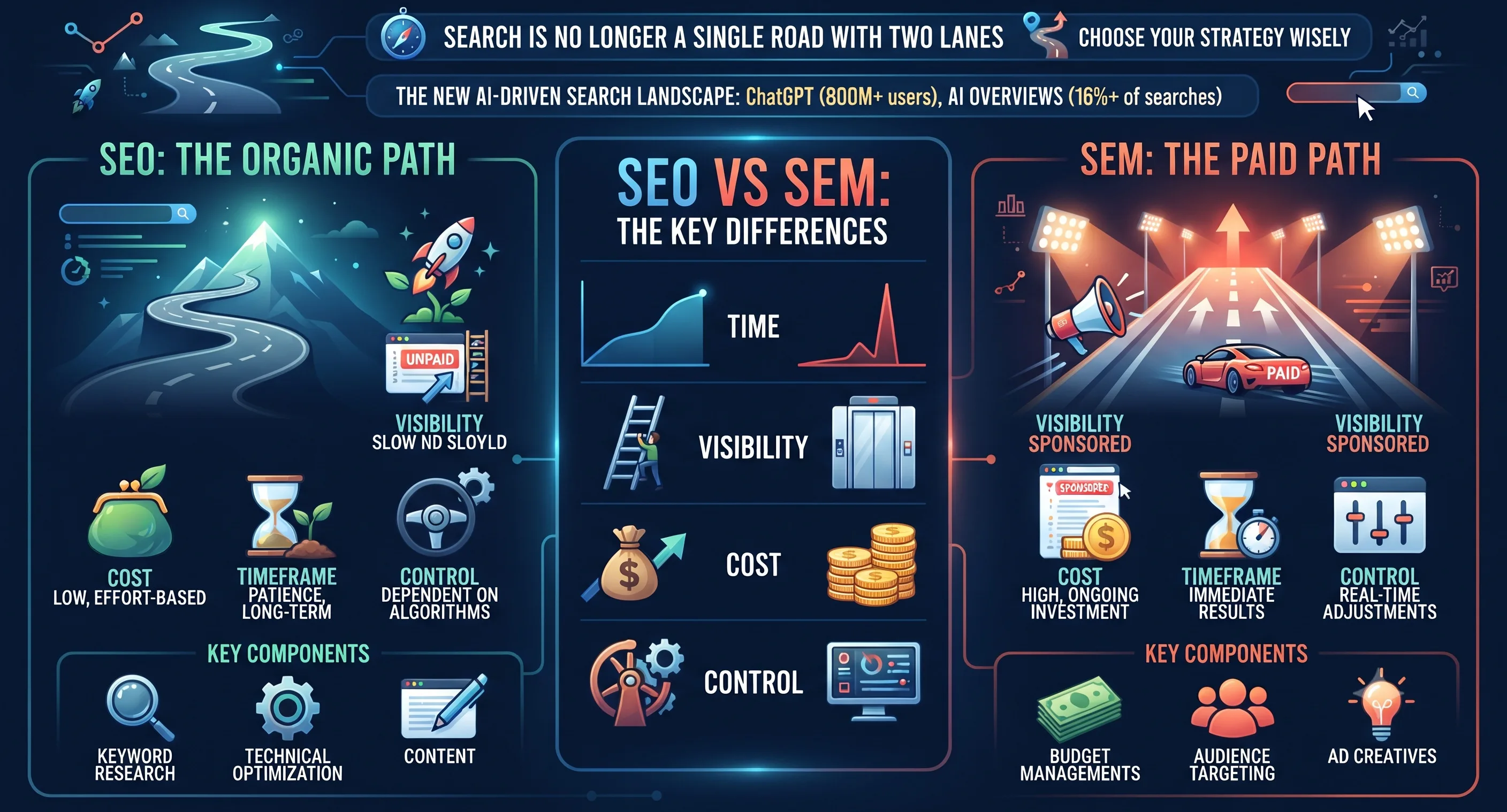
On visibility, SEO improves organic rankings through content optimization and link building, whereas SEM relies on paid placements at the top of SERPs. On control, SEM lets advertisers adjust bidding strategies, targeting, and ad creatives in real time, while SEO depends on search engine algorithms and ranking factors, which makes it less predictable.
Why SEO Delivers Lasting Value
SEO primarily drives organic traffic by attracting relevant visitors who are actively searching for information, products, or services related to your business. Although it takes time, it can deliver sustainable benefits when you consistently publish high quality content and follow best practices. Over time, this establishes your website as a credible authority in your industry. Websites that rank high in search results are also often seen as more trustworthy by users, which helps attract more visitors and potential customers.
Also read:
What Is Answer Engine Optimization and How Does It Differ From Traditional SEO?
Why SEM Delivers Fast and Measurable Results
SEM offers immediate results because bidding on relevant keywords and writing persuasive ad copy can quickly send targeted traffic to your website. It also provides precise targeting based on demographics, interests, geographic location, and search intent. Advertisers can track click through rates, conversion rates, and return on investment, which makes performance easy to evaluate and improve. Budget limits, bid prices, and ad scheduling can all be customized to match your objectives.
Should Marketers Use SEO or SEM?
For most organizations, an effective strategy uses both, because the two complement each other. SEO can help marketers build effective landing pages for SEM campaigns. New sites can use SEM campaigns to generate traffic, which can help them earn backlinks and improve SEO. Organizations with a limited marketing budget may focus strictly on SEO, while teams that need quick results or lack the resources to create optimized content may focus on SEM. However, once organizations can supplement their SEO with SEM, they typically do.
How GEO Adds a New Layer to Search
Generative engine optimization (GEO) is the practice of positioning your brand and content so that AI platforms like Google AI Overviews, ChatGPT, and Perplexity cite, recommend, or mention you. GEO builds on the same SEO fundamentals, but it shifts the focus from rankings and clicks to citations, mentions, and share of voice. The shift is measurable. ChatGPT reaches over 800 million weekly users, Google’s Gemini app has surpassed 750 million monthly users, and AI Overviews appear in at least 16% of all searches.
Also read:
ChatGPT Is Now A “Very Large Online Search Engine” In The EU
For the bootstrapped form builder Tally, ChatGPT became the number one referral source. Between 40 and 60% of cited sources change from month to month, yet brands that show up consistently share entity clarity, extractable content, and a multi platform presence.
Conclusion
SEO and SEM are both essential parts of a comprehensive digital marketing strategy, and each serves a distinct purpose. SEO builds long term authority and low cost organic traffic, while SEM delivers instant visibility with precise targeting and measurable returns. The smartest approach is to combine them, then strengthen your foundation with GEO so your brand also appears in AI generated answers.
Frequently Asked Questions about SEO vs SEM
What is the main difference between SEO and SEM?
SEO earns unpaid visibility through optimization, while SEM typically uses paid advertising to appear in search results.
Which is faster, SEO or SEM?
SEM is faster and can deliver immediate results. SEO may take months or even years for competitive keywords.
Is SEO cheaper than SEM?
Yes, in the long run. SEO does not require paying for clicks, while SEM needs ongoing ad budgets.
Does SEM include SEO?
Technically yes, but the term SEM is usually used to describe paid advertising.
Should a small business choose SEO or SEM?
A business with a limited budget may focus on SEO, while one needing quick results may choose SEM. Using both is ideal when possible.
What is GEO?
GEO is the practice of getting your brand cited or mentioned by AI platforms like Google AI Overviews, ChatGPT, and Perplexity.
Related searches:
How SEO for a Website Turns Visitors Into Leads?