

Google handles roughly five times as many searches as ChatGPT, if you believe OpenAI’s own count. ChatGPT receives about one fifth as many search style queries as Google, and the company counts a search every time a question sends ChatGPT out to the web. Website traffic data tells a very different story, so the measure you quote matters as much as the number itself.
That second point is the one most people will miss. A fifth of Google’s volume sounds enormous. Yet the visits ChatGPT actually sends to websites remain tiny next to Google’s. Both facts are true at once, and they measure different things.
The comparison came from Adam Fry, who leads ChatGPT’s consumer product. He shared it during an open discussion with Alex Kantrowitz of Big Technology at a Monday evening dinner in New York hosted by OpenAI. Big Technology later posted the transcript.
Fry did not say which Google figure he compared against. He also did not say what time period the comparison covers or which regions it includes. Those gaps are worth keeping in mind before the number gets repeated as settled fact.
Kantrowitz asked a fair question. If one conversation contains several questions that need the web, does that count as one search or several? Fry’s answer was direct: “Every time you ask a question and go search the web, that’s a search.”
So the unit is the web lookup, not the conversation. A long chat that triggers five separate lookups would count as five.
Know about:
Fry explained that early users mostly wanted help with writing and coding, tasks nobody would have typed into a search engine. Over the past year, he said, people have added questions about people, places and things that need current information. Finance and health questions have joined them. In his words, the category covers anything users would previously have taken to a traditional search engine.
Does that match how you use it? Many of us now reach for a chatbot at the moment we used to open a search tab.
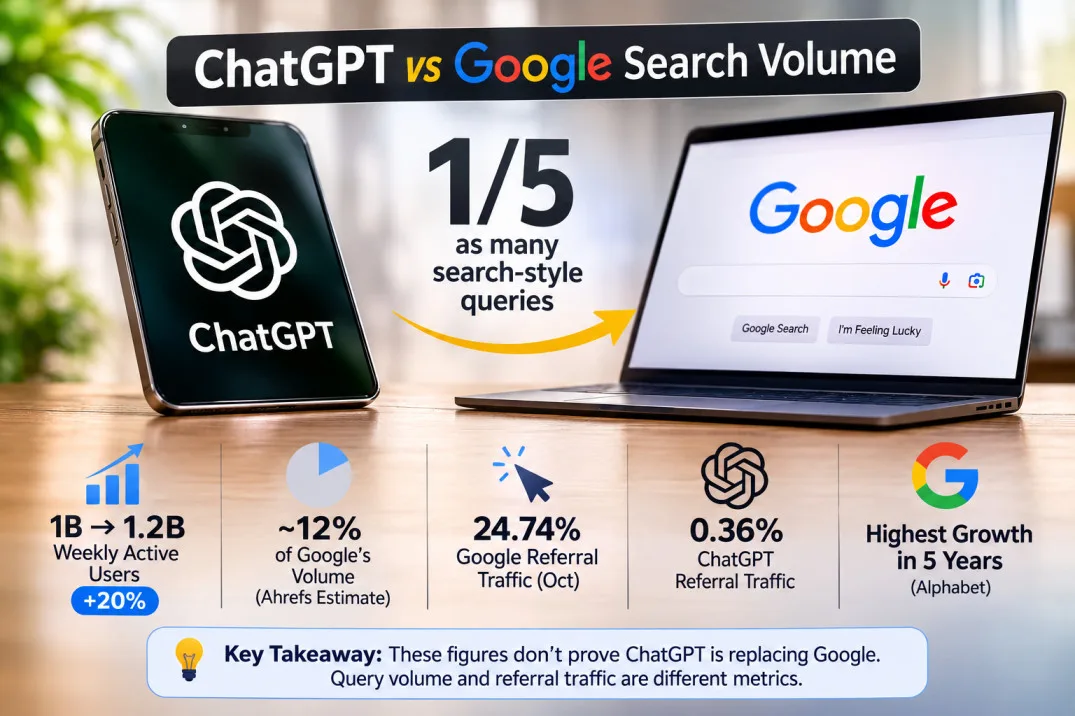
Big Technology’s report also notes that weekly active users of ChatGPT grew from 1 billion to 1.2 billion over the last two months, a rise of 20%.
OpenAI’s number is not the only attempt at this comparison, and the others use different definitions.
In February, Ahrefs estimated that ChatGPT’s search volume was about 12 percent of Google’s. Their starting point was 2.5 billion daily ChatGPT prompts in July 2025, taken from a study by Harvard University and OpenAI. They judged that around 65 percent of those prompts were the kind of query people would once have typed into Google. That total was then set against the more than 5 trillion searches per year that Google announced in March 2025.
The Ahrefs author noted that 65% was higher than the share the researchers themselves had classified as search. The gap between 12 percent and one fifth comes down to method. Ahrefs sorted prompts by the type of request. Fry’s figure counts actual web searches.
Ahrefs also tracks where website traffic comes from across sites using its free Web Analytics tool. In October, across 118,671 sites, Google accounted for 24.74% of tracked traffic. ChatGPT accounted for 0.36%. Those figures come from the tracker’s November 3 update.
This is the number to hold up against the one fifth claim. A chatbot can answer a huge number of questions and still send very few visitors onward, because many answers are consumed without a single click.
Google does not publish a query count in its earnings releases. Alphabet’s third quarter release, which Search Engine Journal covered on October 28, describes search growth as a rate. In the release itself, CEO Sundar Pichai said AI investments are driving overall query growth. He added that the growth rate compared with a year earlier is the highest it has been in five years.
That is a useful counterweight. Whatever ChatGPT is doing, Google reports that its own query growth is accelerating, not shrinking.
Neither Fry’s ratio nor Google’s growth rate shows whether ChatGPT searches are replacing Google searches. They could be additional searches, substitutes, or a mix of both. The data supplied here cannot settle that.
If ChatGPT is part of your channel planning, report it with its definitions attached. Query volume and referral traffic are two separate metrics, and they currently point in opposite directions. Quote the one fifth figure alone and you overstate ChatGPT’s value to a website owner. Quote only the 0.36% and you ignore how many questions people now ask it.
Know about:
ChatGPT Is Now A “Very Large Online Search Engine” In The EU
That is what OpenAI says, using its own counting rule. It is not an independent measurement, and the Google figure it was compared against was not disclosed.
They count different things. OpenAI counts every question that sends ChatGPT to the web. Ahrefs started from total prompts and estimated how many resembled traditional searches, arriving at about 12 percent.
The data here shows the gap but does not explain it. Ahrefs found ChatGPT at 0.36% of tracked traffic against Google’s 24.74%, which shows that answering questions and sending visitors are different outcomes.
Nothing in the supplied information proves that. Fry’s number and Google’s growth rate both fail to show whether ChatGPT searches replace Google searches.
According to Alphabet’s third quarter release, yes. Pichai said the growth rate compared with a year ago is the highest in five years.
Both, clearly labelled. State the query volume claim and the referral traffic data separately, with their sources, so readers can see that they measure different things.