
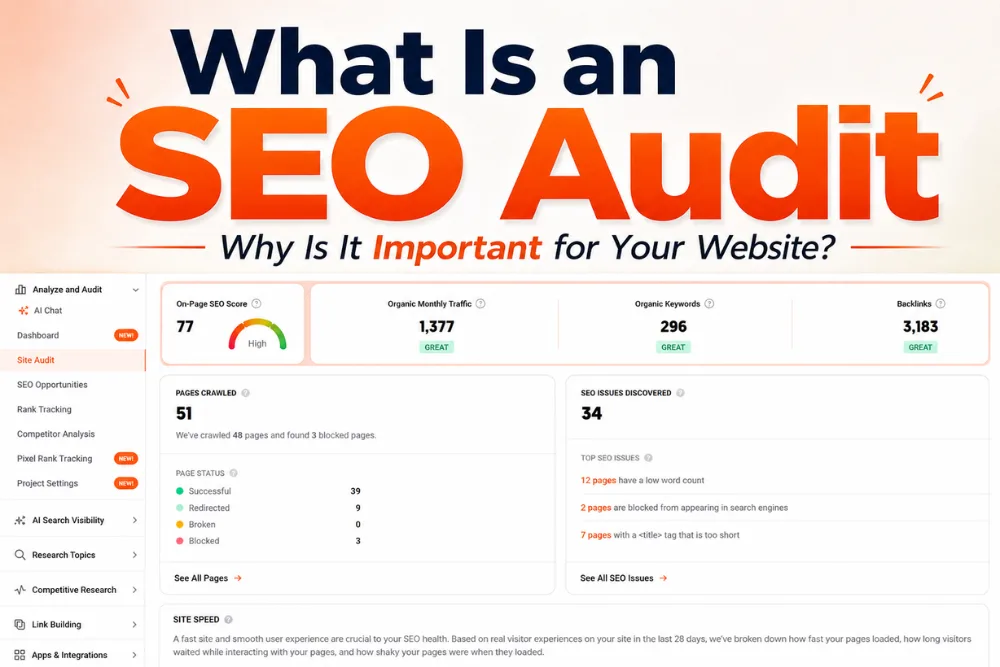
Have you ever wondered why your website is not getting the search visibility or traffic you expected, even after putting in plenty of effort? The answer may be hidden in technical issues, content gaps, poor page performance, or other SEO problems. An SEO audit helps uncover these issues and shows you exactly where your website needs improvement.
Think of an SEO audit as a health check for your website. It looks at how easily search engines can find and understand your pages, how useful your content is, how well your site performs for visitors, and how strong your presence is across the wider web.
As Dony Garvasis explains, an SEO audit gives you a clearer picture of what is working, what needs improvement, and where your biggest SEO opportunities are. Instead of making random changes and hoping for better rankings, an audit provides a structured foundation for deciding what to fix and what to prioritize.
An SEO audit is essentially a health check for your website. It looks at how well your website is performing from a search engine and user experience perspective. Rather than focusing on just one area, an audit examines multiple factors that can affect your visibility, organic traffic, usability, and overall online performance. That’s why many businesses are turning to professional SEO audit services to identify issues and find opportunities for growth.
It’s actually a comprehensive evaluation of your website’s health, visibility, and performance in search engine results. It helps identify technical problems, content gaps, backlink concerns, and user experience issues that may prevent your website from ranking higher, attracting relevant visitors, and delivering the results you want.
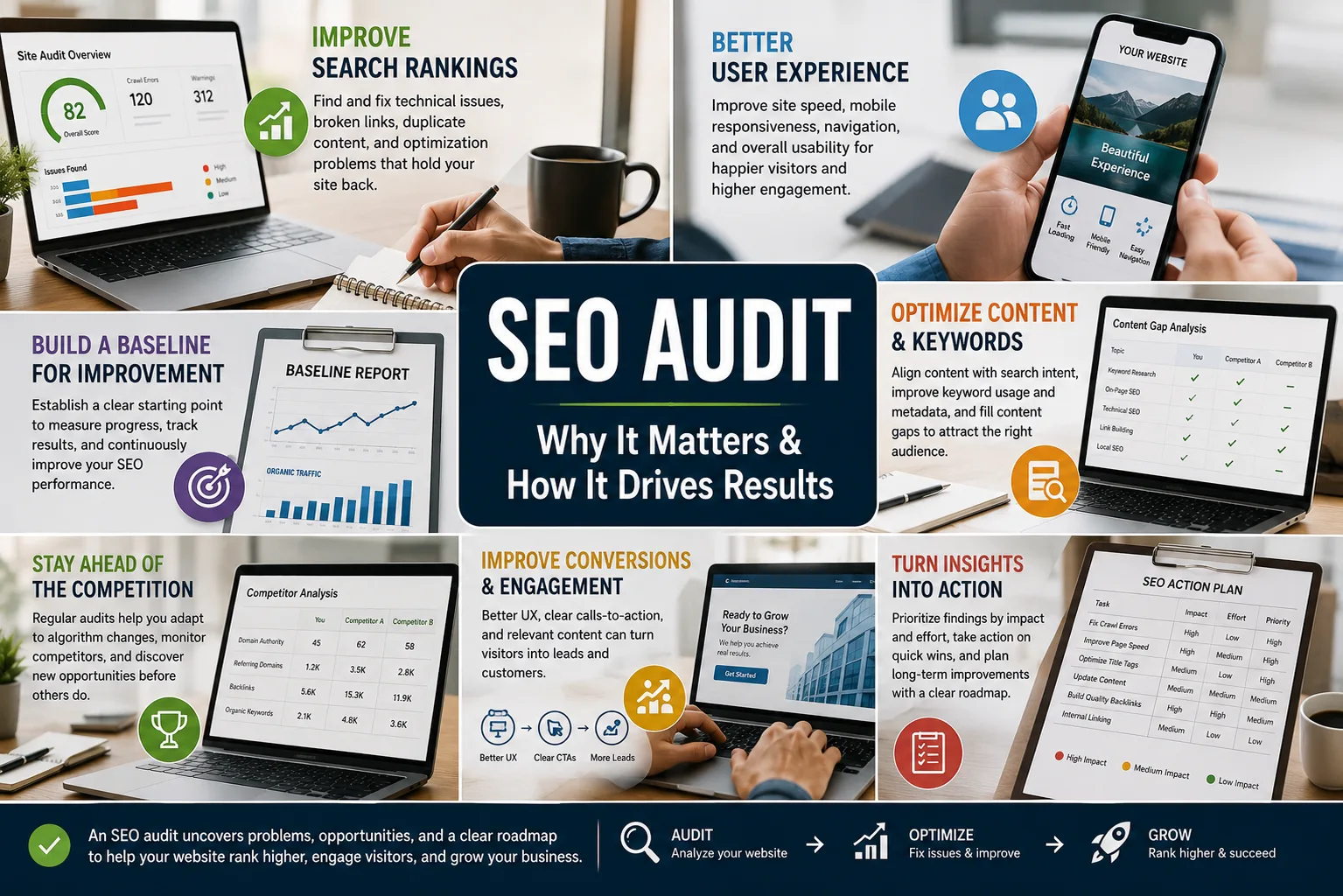
A typical SEO audit examines the technical health of a website, the quality and optimization of individual pages, the website’s backlink profile, its existing content, and the opportunities available for improvement. The goal is to understand what is working well, what is causing problems, and what needs attention.
This type of evaluation can uncover issues that are not always obvious when you simply look at your website from a visitor’s perspective. A page may appear perfectly normal to a user while still having crawlability problems, indexing issues, poor page speed, duplicate content, or other SEO concerns. An audit helps bring these issues to light.
It also provides a clearer picture of how your website is performing in search engine results. By identifying technical roadblocks, content gaps, and user experience problems, an SEO audit creates a foundation for making informed improvements.
Most importantly, an audit is not simply about finding problems. It is about turning those findings into an actionable plan. Once the issues are identified, they can be prioritized according to their impact and the effort required to resolve them.
An SEO audit is important because it provides a comprehensive, data driven analysis of how well your website is optimized for search engines and user experience. Without an audit, important problems can remain unnoticed and continue affecting your website’s visibility, traffic, usability, and effectiveness.
Search engine optimization requires attention to many different areas at the same time. Technical issues can prevent search engines from properly accessing pages. Poor content optimization can make it harder for pages to match search intent. Backlink problems can affect the reputation and authority of a website. User experience issues can make it difficult for visitors to interact with the site.
Also read: How SEO for a Website Turns Visitors Into Leads?
An SEO audit brings these areas together in one evaluation. It helps you understand the current condition of your website and provides recommendations for improvement.
It also creates a baseline for continuous improvement. SEO is not a one time task because search engine algorithms and user behaviour can change over time. Having an audit gives you a starting point from which you can track progress and measure whether your SEO efforts are producing improvements.
Technical SEO is the foundation of an SEO audit. If search engines cannot properly crawl and index your website, improvements in other areas may not deliver the results you expect. That is why technical health needs to be examined carefully.
A technical SEO audit looks at whether search engines can access your pages, understand your website structure, and properly index the content that should appear in search results. It also examines website speed, mobile friendliness, site architecture, and security.
Technical problems can sometimes remain hidden for a long time. A website can look functional to visitors while still having broken links, redirect problems, blocked pages, or unintended indexing restrictions. Identifying these issues is an important part of understanding why a website may not be performing as expected.
Crawlability and indexability are important parts of the technical audit. Search engines need to be able to access and understand the pages on your website. Problems such as broken links, 404 errors, redirect chains, pages blocked by robots.txt, or unintended noindex tags can interfere with this process.
An audit checks for these problems so they can be identified and addressed. Broken links can create poor experiences for visitors, while redirect chains can create unnecessary complications. Pages that are unintentionally blocked or marked as noindex may not appear in search results as expected.
Reviewing crawlability and indexability helps ensure that the website is accessible to search engines and that important pages are not accidentally prevented from being included in search results.
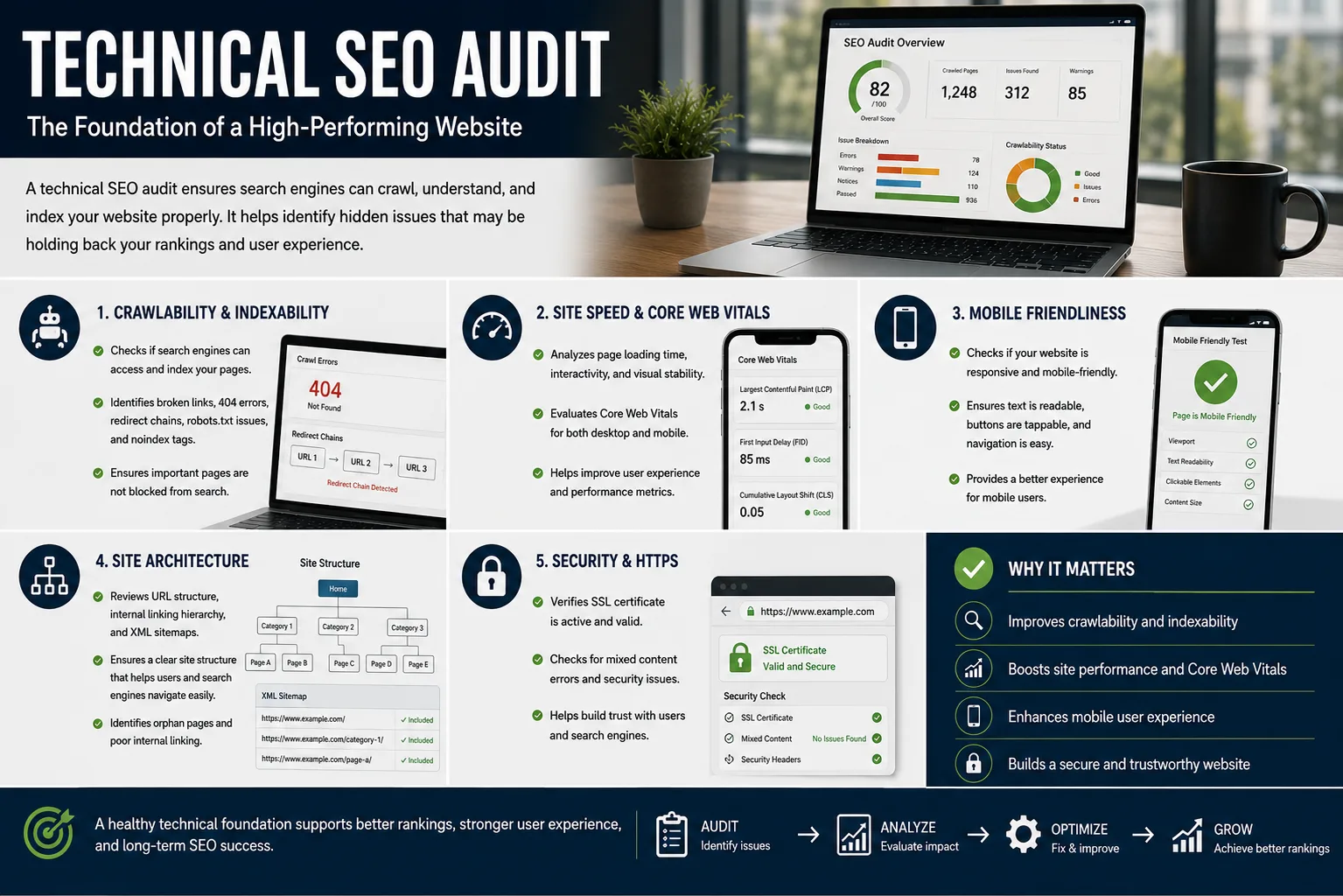
Website performance is another important part of a technical SEO audit. The audit examines page loading times, interactivity, and visual stability across desktop and mobile devices.
A website that loads slowly or does not respond smoothly can create a poor experience for visitors. The audit helps identify performance areas that may need improvement.
Core Web Vitals are also considered when evaluating website performance. Looking at loading, interactivity, and visual stability provides a clearer understanding of how the website performs for visitors.
Improving these areas can support a better user experience while also addressing performance factors that are considered during an SEO evaluation.
Mobile friendliness is essential because visitors may access a website using smartphones and tablets. A technical SEO audit checks whether the website is responsive, readable, and easy to navigate on mobile devices.
A website that does not work properly on smaller screens can make it difficult for visitors to find information or interact with pages. This can negatively affect the overall experience.
An audit therefore checks how the website behaves across mobile devices and identifies areas where the experience may need improvement. Making sure pages are legible and navigation is easy is an important part of maintaining a website that works well for visitors.
Site architecture refers to how the website is structured. An SEO audit evaluates URL structure, internal linking hierarchy, and XML sitemaps to understand how the different pages are organized.
A clear structure can make it easier to navigate the website and understand the relationship between different pages. Internal linking also helps establish a logical hierarchy within the site.
The audit examines whether the current structure is clear and whether improvements are needed. Reviewing URLs, internal links, and XML sitemaps helps provide a more complete picture of the technical organization of the website.
Website security is another area included in a technical SEO audit. The audit verifies that SSL certificates are active and checks for mixed content errors.
Security is important for both website visitors and the overall user experience. Security warnings can make visitors uncomfortable and may cause them to leave a website.
Checking HTTPS and resolving mixed content errors helps ensure that the website provides a secure experience and avoids issues that could affect visitor confidence.
An on page SEO audit focuses on individual pages. The purpose is to make sure each page is properly optimized for its target keywords while also providing clear context for search engines and useful information for visitors.
This part of the audit examines metadata, headings, content quality, search intent, and images. Each of these elements contributes to how clearly a page communicates its topic.
An effective page should make its purpose clear. It should use relevant keywords naturally, provide useful content, and organize information in a way that is easy to understand.
Metadata optimization includes reviewing title tags and meta descriptions. These elements should be unique, compelling, and properly targeted with relevant keywords.
An audit checks whether metadata is appropriate for each page and whether it avoids unnecessary problems such as truncation. Clear metadata can help communicate what a page is about.
Reviewing metadata across the website can also reveal pages that may need improvement. When titles and descriptions are properly aligned with the page content and target keywords, they provide clearer context for search engines and visitors.
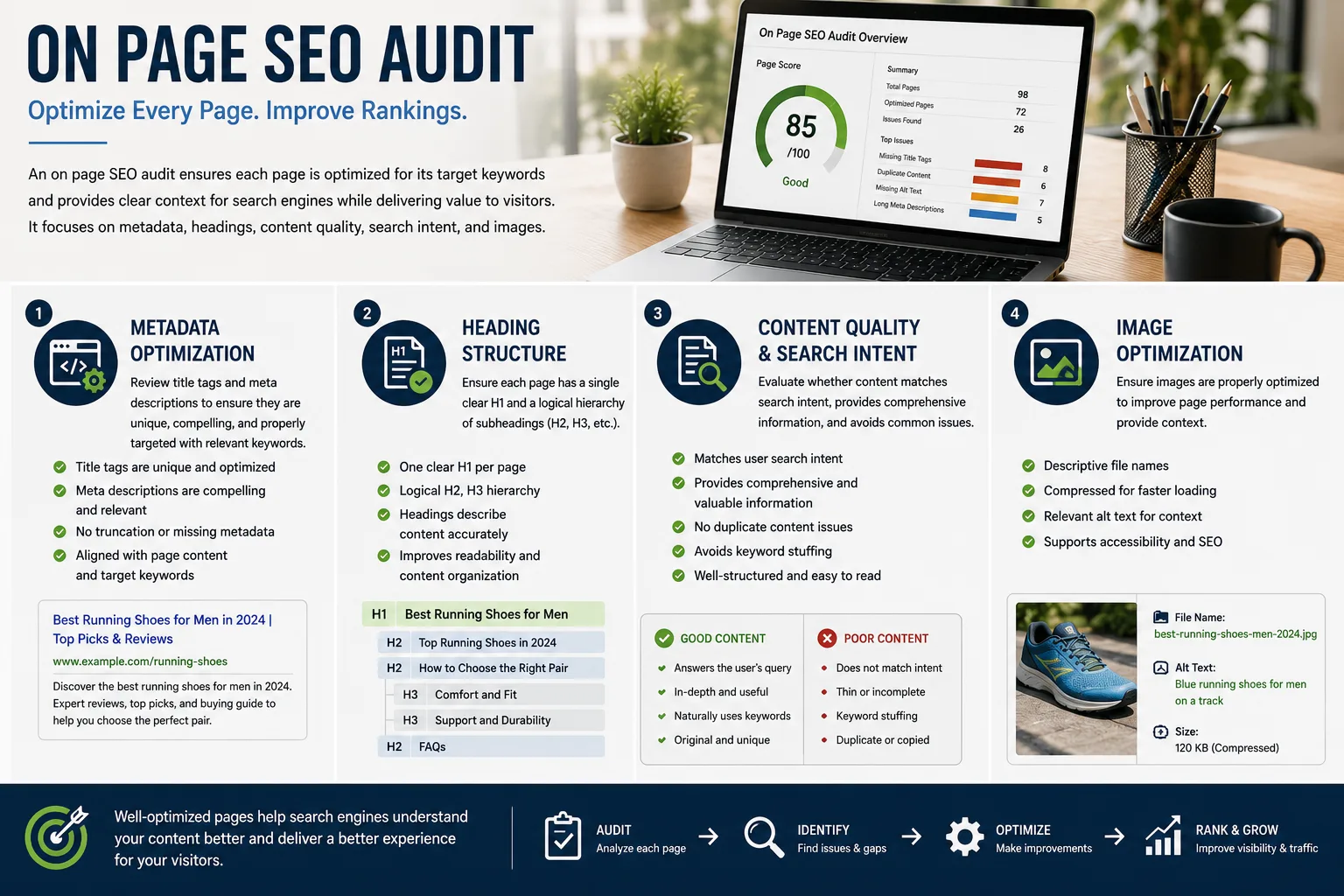
Heading structure is another important part of an on page SEO audit. Pages should have a single clear H1 and a logical hierarchy of subheadings such as H2 and H3 headings.
A clear heading structure makes content easier to understand. It gives visitors a sense of how the information is organized and helps provide context about the page.
During an audit, the heading structure of individual pages is reviewed to identify inconsistencies or opportunities for improvement. A logical hierarchy makes the content clearer and easier to navigate.
Content quality is one of the most important areas of an SEO audit. The audit evaluates whether the content matches search intent, provides comprehensive information, and avoids problems such as duplicate content and keyword stuffing.
Search intent is important because content should address what visitors are looking for. Simply including keywords is not enough. The content needs to provide relevant information and match the purpose behind the search.
An audit helps determine whether existing pages are meeting that expectation. It can identify content that needs improvement and highlight areas where the website may not be providing enough useful information.
Avoiding duplicate content and keyword stuffing is also part of this evaluation. The goal is to ensure that content remains useful and properly aligned with the purpose of the page.
Images are also reviewed during an on page SEO audit. The audit checks descriptive file names, compressed file sizes, and relevant alt text.
Large image files can affect page loading performance, while unclear file names provide less useful information about the image. Relevant alt text also helps provide context about images.
Reviewing image optimization ensures that visual elements are properly considered as part of the overall page experience. It is another area where small improvements can contribute to a better website.
An SEO audit also looks beyond the website itself. The off page SEO and backlink audit evaluates the website’s authority and reputation across the wider web.
Backlinks are an important part of this evaluation. The audit reviews the total number of backlinks, referring domains, and overall domain authority. This provides insight into the website’s backlink profile.
Looking at backlinks is important because not every link has the same value. An audit can help identify opportunities to strengthen the website’s authority while also identifying links that may require attention.
The health of the backlink profile is evaluated by reviewing the number of backlinks, referring domains, and overall domain authority.
This gives a clearer understanding of how the website is represented across the wider web. The audit can identify areas where the backlink profile may be strong and areas where improvements may be needed.
Understanding the backlink profile is useful when creating a broader SEO strategy because it shows what is happening outside the website itself.
An audit also looks for spammy, low quality, or manipulative links that could create problems. These links can be flagged for disavowal when appropriate.
The purpose of this review is to identify backlinks that may be harmful rather than helpful. Examining the backlink profile carefully helps ensure that potential concerns are not overlooked.
This process is particularly useful when a website has accumulated a large number of backlinks over time. Reviewing the quality of those links provides a clearer picture of the website’s overall off page SEO health.
Anchor text distribution is another area reviewed during a backlink audit. The goal is to determine whether anchor texts appear natural or whether they look over optimized.
A natural looking backlink profile is important when evaluating the overall health of a website’s links. An audit can identify patterns that may need further attention.
By reviewing anchor text distribution alongside the rest of the backlink profile, the audit provides a more complete understanding of the website’s off page SEO situation.
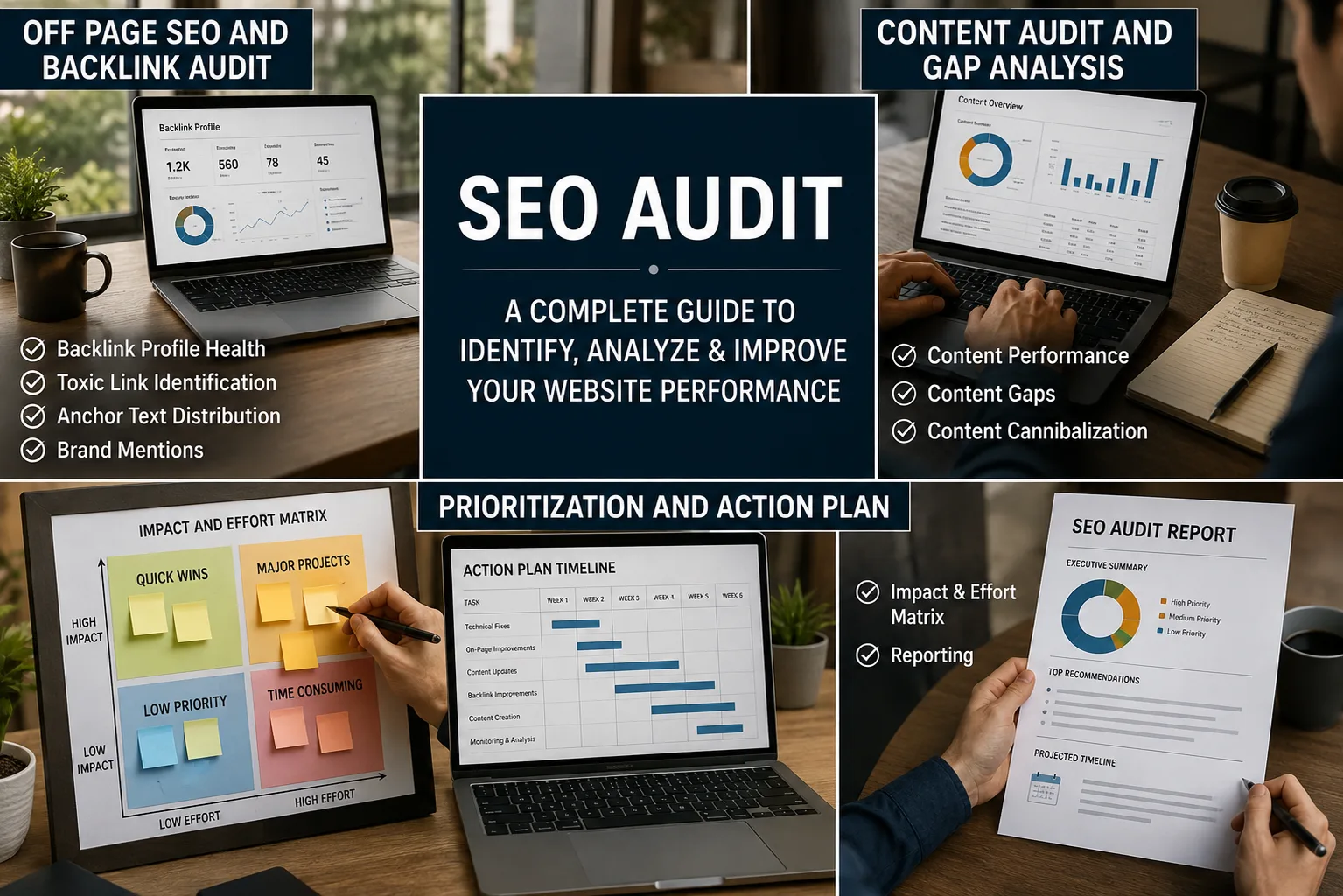
An audit can also identify unlinked brand mentions across the wider web. These mentions may represent opportunities to strengthen the website’s backlink profile.
Finding these opportunities is part of understanding how a brand is represented online. When relevant unlinked mentions are identified, they can potentially be converted into backlinks.
This makes brand mentions another useful area to review when evaluating the website’s authority and reputation.
A content audit evaluates the website’s existing content library. The goal is to understand what is performing well, what is underperforming, and what areas need improvement.
Content plays an important role in attracting relevant visitors and increasing organic traffic. However, simply having a large amount of content does not guarantee strong performance.
An audit helps identify which pages are providing value and which pages may be contributing little to the overall website. It also identifies topics that are missing and pages that may be competing with one another.
Content performance can be evaluated using analytics tools. The audit looks at top performing pages, underperforming pages, and pages with zero traffic.
This helps create a clearer picture of how the existing content library is performing. Strong pages can provide insight into what is working, while weak pages can reveal opportunities for improvement.
Pages with zero traffic may also require attention. Identifying this dead weight helps ensure that the content library is evaluated based on actual performance rather than simply the number of pages available.
Content gap analysis compares your content against top competitors to identify valuable keyword topics that your website does not currently cover.
This can reveal opportunities to create or improve content. Instead of guessing which topics may be useful, the audit provides a structured way to identify areas that are currently missing.
Content gaps are important because they can prevent a website from fully addressing relevant searches. Identifying those gaps helps create a clearer direction for future content improvements.
Content cannibalization occurs when multiple pages on the same website compete for the same keywords. An SEO audit can identify these situations.
When several pages target the same keywords, it can become difficult to understand which page should be the main result for that topic. Reviewing the content library helps identify these overlaps.
Once identified, these situations can be considered as part of the broader action plan. The goal is to make the content structure clearer and ensure that pages have distinct purposes.
An SEO audit is only as valuable as the actions that follow it. Finding problems is useful, but the real benefit comes from turning those findings into a clear and practical roadmap.
The final phase of an audit focuses on prioritization. Not every issue requires the same amount of time or effort, and not every problem has the same potential impact.
A good action plan helps organize the findings so that the most important improvements receive attention first. This makes the audit more useful and helps turn analysis into measurable progress.
The impact and effort matrix helps categorize SEO fixes according to their expected impact and the amount of work required.
Quick wins are improvements that can have a high impact while requiring relatively low effort. Long term projects can have high impact but require more time and resources. Low priority tasks can be addressed later when more important improvements have been completed.
This approach makes the SEO audit easier to act upon. Instead of having a long list of problems without direction, the website owner has a clearer understanding of what should happen first.
Reporting is the final part of the audit process. A comprehensive report outlines the findings, prioritized recommendations, and projected timelines for improvement.
A useful report should make the results easy to understand. It should explain what was discovered and provide clear recommendations based on those findings.
The report also creates a reference point for future progress. Since SEO requires ongoing adjustments, having documented findings makes it easier to compare performance and measure improvements over time.
One of the main reasons an SEO audit is important is that it can identify issues that hurt search visibility. Technical problems, broken links, slow loading pages, crawl errors, duplicate content, and improper use of keywords and metadata can all affect website performance.
Without an audit, these issues may remain unnoticed. A website owner may continue creating content or making other improvements without addressing the underlying problems.
An audit provides a structured way to find these issues. Once they are identified, they can be prioritized and addressed according to their impact.
This creates a stronger foundation for improving search rankings. Rather than making changes without a clear understanding of the website’s condition, an audit provides information that can guide the next steps.
SEO is not only about search engines. An audit also examines how visitors experience the website.
Mobile responsiveness, page speed, website security, navigation, and content quality can all influence how people interact with a website. If visitors struggle to navigate a page, find information, or use the website on a mobile device, the overall experience can suffer.
An SEO audit can reveal these issues and provide opportunities for improvement. Better page performance and easier navigation can help create a smoother experience for visitors.
The audit can also reveal user experience issues that affect engagement, such as unclear calls to action or difficult navigation. Improving these areas can ultimately support better engagement, leads, and sales.
Content and keywords need to work together with search intent. An audit reviews content quality, keyword usage, and metadata to determine whether pages are properly optimized.
This process helps identify content that does not fully address the needs of visitors. It can also reveal pages that need stronger keyword targeting or better organization.
By improving content based on the findings of an audit, a website can work toward attracting more relevant visitors and increasing organic traffic.
The focus is not simply on adding more keywords. The content should match search intent, remain comprehensive, and avoid keyword stuffing. This creates content that is more useful to visitors while also providing clearer context for search engines.
SEO requires continuous adjustment. Search engine algorithms change, user behaviour changes, and website performance can change over time.
An SEO audit provides a baseline that can be used to track progress. It shows the current condition of the website before improvements are made.
With this baseline, future audits and performance reviews can be compared against the original findings. This helps measure the effectiveness of SEO strategies and identify areas that still require attention.
Rather than treating SEO as a one time activity, an audit supports a continuous process of evaluation and improvement.
Regular SEO audits can help websites adapt to changing search engine algorithms and user behaviour. They also provide an opportunity to identify problems before they become larger concerns.
Competitors are also constantly working to improve their websites. Reviewing your own content, backlink profile, technical performance, and website structure can help identify areas where your website needs to improve.
Content gap analysis is especially useful because it can reveal valuable topics that competitors are covering while your website is not.
By regularly reviewing these areas, you can maintain a clearer understanding of your website’s position and identify opportunities for continued improvement.
An SEO audit can go beyond search rankings and traffic. It can also reveal issues that affect how visitors engage with the website.
Difficult navigation and unclear calls to action can make it harder for visitors to take the desired next step. An audit can help identify these user experience concerns.
Improving these areas can create a more effective website experience. When visitors can navigate the website more easily and understand what actions they can take, engagement can improve.
This can ultimately support business goals such as generating leads and increasing sales. In this way, the value of an SEO audit extends beyond search engine visibility.
Also read: Why SEO Services for Small Business Are Worth the Investment
An SEO audit should be viewed as part of an ongoing SEO process rather than a one time activity. The provided information emphasizes that SEO requires ongoing adjustments because search engine algorithms and user behaviour can change.
Regular audits can help identify new issues, evaluate existing performance, and provide an updated baseline for improvement.
The exact timing can depend on the website and its needs, but the important point is that SEO should be monitored continuously. An audit gives you the information needed to understand what has changed and what should be addressed next.
The most important step after an SEO audit is turning the findings into action. An audit provides information about technical problems, content gaps, backlink concerns, user experience issues, and other areas that may need attention.
The findings should then be organized according to impact and effort. Quick wins can be addressed first, while larger projects can be planned for the longer term.
A comprehensive report can guide this process by outlining findings, recommendations, and projected timelines.
This approach prevents the audit from becoming just a document filled with information. Instead, it becomes a practical roadmap for improving the website.
A professional SEO audit provides a comprehensive and data driven view of how well a website is optimized for search engines and users.
It can uncover problems that may otherwise remain unnoticed, from broken links and crawl errors to content gaps and backlink concerns. It can also reveal user experience issues involving mobile responsiveness, page speed, navigation, and calls to action.
The biggest advantage is that the audit brings all these areas together. Instead of looking at individual problems separately, you get a broader understanding of your website’s current performance.
That information can then be used to create a prioritized action plan. This makes it easier to focus time and effort on improvements that matter most.
An SEO audit is a health check for your website that examines technical performance, on page optimization, backlinks, content, user experience, and opportunities for improvement. Its importance comes from the clear picture it provides. I am Dony Garvasis, a freelance SEO consultant, and I believe a detailed SEO audit should be the foundation of every successful SEO campaign. I analyze your website to uncover the issues and opportunities that may be preventing it from achieving higher search rankings. More importantly, I turn those findings into a clear action plan focused on improving visibility, user experience, and organic traffic.
An SEO audit is a comprehensive evaluation of a website’s health, visibility, and performance in search engine results. It identifies technical problems, content gaps, backlink concerns, and user experience issues that may affect performance.
An SEO audit is important because it identifies issues that can hurt search visibility, user experience, traffic, engagement, and overall website effectiveness. It also provides a clear action plan for improvement.
A technical SEO audit checks crawlability, indexability, broken links, redirects, page speed, Core Web Vitals, mobile friendliness, site architecture, XML sitemaps, and website security.
An on page SEO audit reviews title tags, meta descriptions, heading structure, content quality, search intent, keyword usage, duplicate content, keyword stuffing, and image optimization.
Backlinks are included because they provide information about a website’s authority and reputation across the wider web. An audit can identify backlink opportunities and potentially harmful links.
A content gap analysis compares your existing content against top competitors to identify valuable keyword topics that your website does not currently cover.
Content cannibalization occurs when multiple pages on the same website compete for the same keywords. An SEO audit can identify these competing pages.
Yes. An audit can identify issues involving mobile responsiveness, page speed, security, navigation, content, and calls to action that may affect how visitors interact with a website.
An audit identifies problems and opportunities, but improvements depend on implementing the recommendations. The audit provides the information and action plan needed to work toward better search performance.
No. SEO requires ongoing adjustments because search engine algorithms and user behaviour can change. Regular evaluation helps establish a baseline, track progress, and identify new opportunities for improvement.
The final step is prioritization and reporting. Findings are organized according to impact and effort, and a comprehensive report outlines recommendations and projected timelines for improvement.