

The most effective SEO strategies for a law firm in Australia include local SEO, Google Business Profile optimisation, dedicated practice area pages, strong E E A T signals, technical SEO, and authoritative local link building. Because legal services are high stakes and fall under Google’s YMYL category, Australian law firms need to demonstrate expertise, experience, authority, and trust throughout their website.
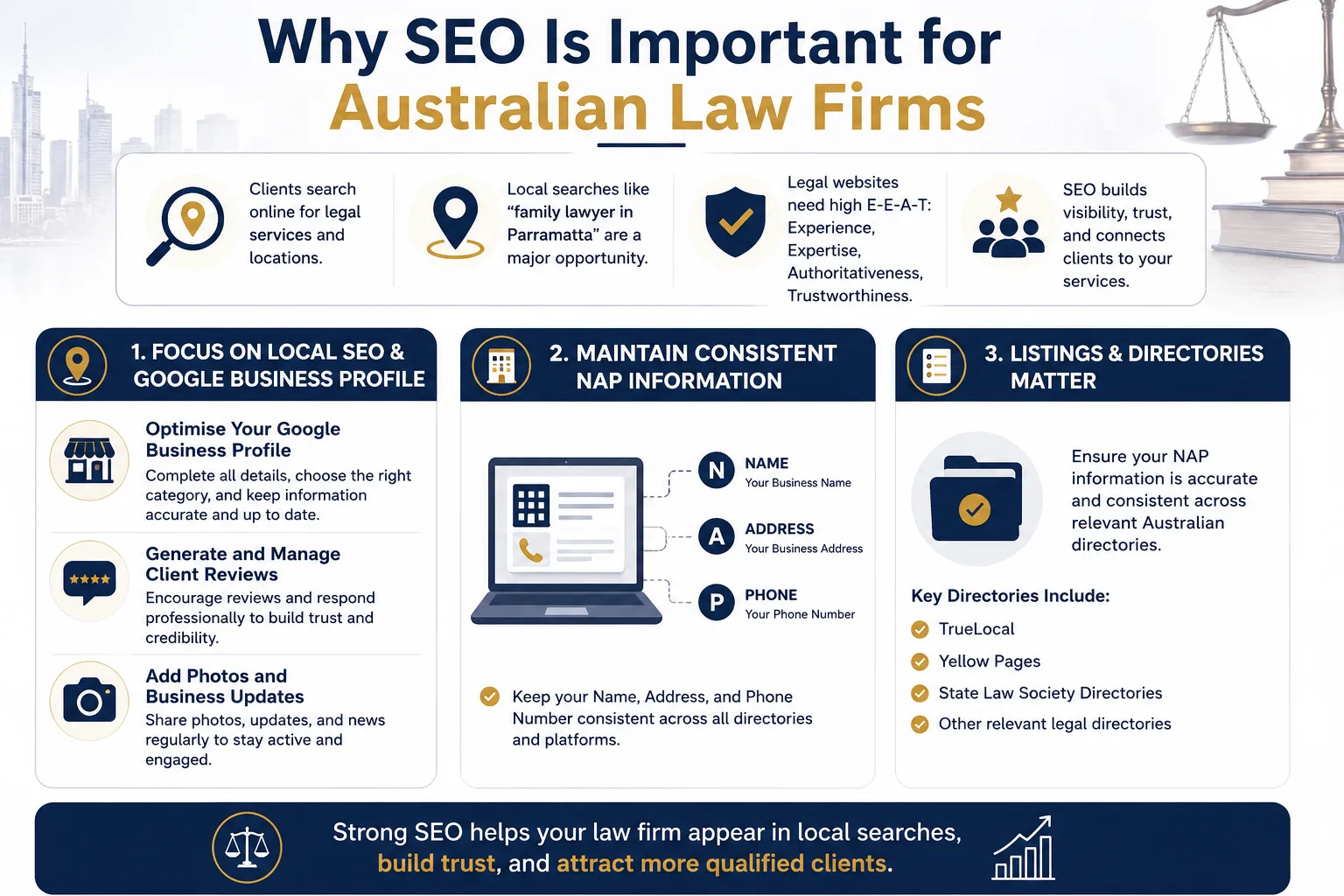
SEO is especially important for law firms because potential clients often search online when they need legal assistance. These searches are frdvequently specific to both the legal service and the client’s location.
For example, someone may search for a family lawyer in Parramatta or a criminal solicitor in Melbourne. This makes local search an important opportunity for law firms that want to attract people who are actively looking for legal services in their area.
Legal websites also face a higher level of scrutiny because legal information can have a significant impact on people’s lives. Google’s E E A T principles, which stand for Experience, Expertise, Authoritativeness, and Trustworthiness, are therefore particularly important for law firm websites.
Successful SEO strategies should not focus only on rankings. It should also help potential clients understand the firm’s expertise, services, location, credibility, and how they can get in touch.
Local SEO should be one of the main priorities for an Australian law firm. Many potential clients want legal representation close to where they live or work.
A properly optimised Google Business Profile can help a law firm appear in local search results and the Local 3 Pack, which can generate valuable calls and consultation opportunities.
Start by claiming and verifying your Google Business Profile. Complete every relevant section and make sure the information accurately represents your firm.
Your business name, address, and phone number should be accurate and consistent. Your operating hours should also be kept up to date.
Choosing the right primary category is important. The category should accurately represent the firm’s core service, such as Personal Injury Lawyer or Family Law Firm. Relevant secondary categories can also be added where appropriate.
A complete and accurate profile gives search engines useful information about your firm and helps potential clients understand what services you provide.
Reviews are another important part of local SEO.
Satisfied clients can be encouraged to leave Google reviews. These reviews can provide social proof for potential clients who are considering contacting the firm.
Law firms should also respond professionally to both positive and negative reviews. Active review management can demonstrate engagement and client care.
A Google Business Profile should not remain static.
Law firms can regularly add high resolution photographs of their office, team, and community activities. They can also use Google Business Profile posts to share legal updates and firm news.
Keeping the profile active provides additional information for people researching the firm and helps demonstrate that the business is engaged with its audience and community.
NAP refers to Name, Address, and Phone Number.
Consistency is important because search engines can use business information from different websites and directories to verify the legitimacy of a business.
Law firms should check their listings across relevant directories and make sure their business information matches their Google Business Profile.
Even small differences in formatting can create inconsistencies. For example, using different versions of a street name across different listings can create unnecessary confusion.
Australian law firms should maintain consistent information across relevant Australian business and legal directories, including sources such as TrueLocal, Yellow Pages, and state law society directories.
A law firm should not rely on one general legal services page to target every service it provides.
Instead, create dedicated pages for individual practice areas and specific legal services.
For example, a firm may create separate pages for divorce property settlements, commercial lease disputes, and unfair dismissal.
These dedicated pages allow the firm to provide detailed information about individual services and address the specific needs of potential clients.
Location is particularly important for local legal searches.
Law firms should naturally include geographic terms within relevant service pages, page titles, headings, and other important areas of the website.
For example, searches can combine a legal service with a location, such as a family lawyer in Parramatta or a criminal solicitor in Melbourne.
The objective is to clearly communicate which geographic areas the firm serves and which legal services it provides.
Content should also address legal questions that are relevant to the firm’s target audience.
A law firm can create blog posts and FAQ sections that address local legal questions, state specific regulations, and courthouse procedures relevant to its audience.
This approach allows the website to answer specific questions that potential clients may search for before contacting a lawyer.
Law firm websites should create content that answers the exact questions potential clients are asking.
For example, someone may search for a question such as, “What are the first steps in a QLD divorce proceeding?”
Creating content that directly addresses questions like this can help a law firm connect its expertise with the needs of potential clients.
This approach is also relevant to Answer Engine Optimisation, or AEO.
FAQ sections can be used to provide direct answers to common legal questions. FAQ schema markup can also be implemented on relevant pages to help search engines understand the content and potentially make the information eligible for enhanced search visibility.
E E A T is particularly important for legal websites because legal services fall within Google’s YMYL category.
A law firm needs to demonstrate experience, expertise, authority, and trust throughout its website.
One of the most effective ways to do this is by providing detailed information about the lawyers who work at the firm.
Every lawyer profile should provide useful information about the solicitor’s professional background.
Profiles can include admission dates, practising certificate numbers, professional memberships, and links to LinkedIn profiles.
Professional memberships can include organisations such as the Queensland Law Society or the Law Institute of Victoria.
Detailed solicitor profiles help potential clients understand who may be handling their legal matter and provide evidence of professional competency.
Case studies can also help demonstrate a law firm’s experience.
Law firms can publish real world case outcomes or settlement successes where appropriate. Client confidentiality must be protected, so information should be suitably anonymised.
Case studies can demonstrate the firm’s experience in areas such as court matters and negotiations while giving potential clients a better understanding of the firm’s track record.
Legal websites must also consider compliance.
Content and marketing materials should follow applicable state based legal advertising and marketing regulations. Law firms should be careful about claims made on their websites and ensure their content follows relevant requirements and guidelines.
The content provided also highlights the importance of guidelines associated with the Law Council of Australia and relevant local state bodies.
Building trust through SEO is not simply about ranking higher. A law firm must also ensure that its online communication is responsible and appropriate for the legal sector.
Technical SEO is another important part of an effective strategy.
Many people search for legal help using smartphones, particularly when dealing with urgent matters. If a website is slow, difficult to navigate, or difficult to read on a mobile device, potential clients may leave and choose another law firm.
A law firm website should have a responsive design that works properly across mobile devices.
Text should be easy to read, navigation should be straightforward, and important contact elements should be easy to access.
Phone numbers should be easy to tap, and contact forms or consultation booking options should work smoothly on mobile devices.
Page speed can have an important impact on the user experience.
As a freelance seo consultant, I always tell my clients that SEO is a must, but it should come after creating a strong user experience. Before focusing heavily on rankings, make sure your website is fast, responsive, easy to navigate, and genuinely useful to visitors.
Core Web Vitals are essential, especially page speed. A website that loads quickly and provides a smooth user experience creates a stronger foundation for SEO, conversions, and long-term organic growth.
The provided content recommends aiming for load times under 2.5 seconds. Law firms can work toward this goal by optimising images and maintaining clean website code.
A faster website can make it easier for potential clients to access important legal information and contact the firm.
HTTPS is essential for a professional law firm website.
Because potential clients may submit confidential information through enquiry forms, a secure HTTPS connection can help build trust and protect client enquiry data.
Security is therefore an important part of both the technical website experience and the overall trustworthiness of a legal website.
SEO should ultimately help potential clients take the next step.
Australian legal consumers may want clarity about fees before deciding whether to contact a law firm. For this reason, law firms should clearly explain applicable fee structures.
Depending on the service, this may include fixed fees, hourly rates, or no win no fee arrangements where applicable.
Important conversion elements should also be easy to find.
Click to call buttons and consultation booking forms can be placed prominently on relevant pages, including above the fold, so potential clients can quickly contact the firm.
Backlinks remain an important part of building authority.
Established legal directories and legal websites can be difficult to compete with, so law firms need to develop authoritative local backlinks.
The goal should be to earn links from relevant and reputable sources rather than simply collecting a large number of links.
One approach is to become involved with the local community.
Law firms can sponsor local community groups, sports clubs, charities, or chambers of commerce. These activities can create opportunities to earn local backlinks while also strengthening the firm’s presence within its community.
Local links can help demonstrate geographic relevance and authority.
Lawyers can also contribute expert commentary to Australian news outlets and journalism platforms.
Providing legal expertise or quotes to journalists can create opportunities for high authority media mentions and backlinks.
Platforms such as SourceBottle can be used to connect experts with media opportunities.
Media commentary can therefore support both authority building and brand visibility.
Structured data can help search engines understand important information about a law firm.
Law firms can implement LocalBusiness or LegalService schema markup on their websites.
This structured information can help search engine crawlers understand details such as the firm’s name, address, phone number, operating hours, and services.
Proper structured data can also make a website eligible for enhanced search features.
A strong local SEO strategy combines several elements rather than relying on one tactic.
A law firm should maintain an accurate and complete Google Business Profile, generate and manage reviews, maintain consistent NAP information, create location focused website content, and build authoritative local backlinks.
The website should also clearly communicate the legal services offered and the locations served.
When these elements work together, the firm can create a stronger local presence and make it easier for potential clients to discover and contact the business.
Content should be closely connected to the services a firm actually provides.
Instead of publishing only broad legal topics, law firms can create detailed content around specific practice areas and questions.
Dedicated service pages can explain individual services, while blog posts and FAQs can answer common questions.
For example, a firm focusing on family law can develop content around divorce property settlements and specific questions related to divorce proceedings.
This approach allows the website to address specific user intent while demonstrating knowledge of the firm’s practice areas.
SEO for a law firm should not be treated as a purely technical activity.
Potential clients need to trust the firm before making contact. Detailed solicitor profiles, professional memberships, case studies, client reviews, transparent fee information, secure website technology, and clear contact options can all contribute to that trust.
The website should make it easy for visitors to understand the firm, its services, its location, and the next step they can take.
The most effective SEO strategy for an Australian law firm combines local SEO, Google Business Profile optimisation, dedicated practice area pages, high quality content, strong E E A T signals, technical SEO, mobile optimisation, structured data, and authoritative local link building.
Local search should be a major priority because many potential clients search for lawyers based on both their legal needs and geographic location. Maintaining accurate business information, generating reviews, creating location focused content, and earning local backlinks can strengthen local visibility.
At the same time, legal websites need to demonstrate expertise and trust. Detailed solicitor profiles, professional credentials, anonymised case studies, transparent fee information, and appropriate legal marketing practices can help establish credibility.
A strong technical foundation is equally important. A mobile friendly website, fast page speed, HTTPS security, clear contact options, and appropriate structured data can improve the experience for people searching for legal assistance.
In my opinion, the strongest approach is to combine all of these areas into one consistent SEO strategy. Rather than focusing only on rankings, an Australian law firm should build a website that clearly demonstrates expertise, answers relevant legal questions, serves its local audience, and makes it easy for potential clients to take the next step.
Local SEO is one of the most important strategies because many potential clients search for legal services based on their geographic location. A well optimised Google Business Profile, consistent NAP information, local content, reviews, and local backlinks can all support local visibility.
Google Business Profile can help a law firm appear in local search results and the Local 3 Pack. A complete profile with accurate business information, appropriate categories, reviews, photos, and updates can help potential clients find and evaluate the firm.
A law firm can demonstrate E E A T through detailed solicitor profiles, professional memberships, admission information, practising certificate numbers, LinkedIn profiles, anonymised case studies, and content that demonstrates professional expertise.
Yes. Dedicated practice area pages allow law firms to provide detailed information about individual services and target specific search intent. Examples include divorce property settlements, commercial lease disputes, and unfair dismissal.
Law firms can improve local visibility by optimising their Google Business Profile, maintaining consistent NAP information, creating localised website content, implementing LocalBusiness or LegalService schema, generating reviews, and earning authoritative local backlinks.
Many people use smartphones when searching for legal help, particularly for urgent matters. A mobile friendly website with fast loading pages, readable text, easy navigation, click to call buttons, and accessible contact forms can provide a better experience for these users.
Authoritative local backlinks can help strengthen a law firm’s authority and geographic relevance. Local sponsorships, community organisations, legal associations, regional publications, and media commentary can create opportunities for relevant backlinks.
Law firms can publish anonymised case studies to demonstrate experience and provide evidence of their work in court or negotiations. Client confidentiality should always be protected when publishing case information.
The provided strategies include optimising images and maintaining clean website code. The recommended target is a page load time under 2.5 seconds.
A detailed solicitor profile can include admission dates, practising certificate numbers, professional memberships, and LinkedIn profiles. This information helps demonstrate professional competency and expertise.